Why a Phoenix website needs a map, not just a city name
Phoenix had over 1.6 million residents at the 2020 census, and the metro area is estimated at 5.19 million. The city alone covers about 518 square miles, which makes it the largest city by area in Arizona. That matters for a local business site. Someone in Ahwatukee and someone in Desert Ridge both live in Phoenix, but they are a 40-minute drive apart on I-10 and Loop 101. When they search for an AC technician, Google leans on where they are, not just on the word "Phoenix".
So the first job on any Phoenix site is to make your real service area obvious. That means naming the parts of the Valley you actually cover, both on the page and in your Google Business Profile.
What people in Phoenix search for, by trade
Here is Google's monthly search volume for common services plus "phoenix". It shows how many people are looking for each kind of business in the city every month.
Plumbers lead the trades at 8,100 searches a month, followed by auto repair and hair salons at 5,400 each and dentists at 4,400. Landscaping and real estate agents sit at 2,900. HVAC shows 1,600 for "hvac phoenix", but that number undercounts the real demand, because most people type "ac repair" instead, often with their suburb.
How Phoenix searchers talk about the city
People rarely say "Phoenix" when they mean their part of it. They say:
- Neighborhoods and villages: Arcadia, Ahwatukee, Biltmore, Desert Ridge, Laveen, Maryvale, Encanto, North Mountain and Deer Valley
- Neighboring cities: Scottsdale, Tempe, Mesa, Chandler, Gilbert, Glendale and Peoria, each a separate market on Google
- Roads: I-10, I-17, Loop 101, Loop 202, SR 51 and big streets like Camelback Road
- Landmarks: Camelback Mountain, South Mountain Park, Sky Harbor airport, Chase Field and the Desert Botanical Garden
We use these to write service area pages that read like someone local wrote them. A page for Ahwatukee can mention South Mountain and the I-10 corridor. A page for Arcadia can talk about older ranch homes near Camelback. We only use them where they help a customer recognize their area.
| What people type into Google | US searches per month |
|---|---|
| web design phoenix | 1,900 |
Heat changes what a Phoenix site should show first
Phoenix summers are long and very hot, and that shapes local searches. When an AC unit fails in July, the customer is not browsing. They want a number to call and a sign that you can come today.
For trades that live on summer emergencies, we put these at the very top of the phone screen:
- A tap-to-call button and your hours, including whether you take after-hours calls
- "Same-day service in [your areas]" if it's true
- Your Google rating and number of reviews
- Your Arizona Registrar of Contractors license number if your trade needs one
Pool service, pest control and roofing have their own seasonal peaks too. Monsoon storms bring roof and tree calls. A good site has pages ready for those moments rather than one generic services page.
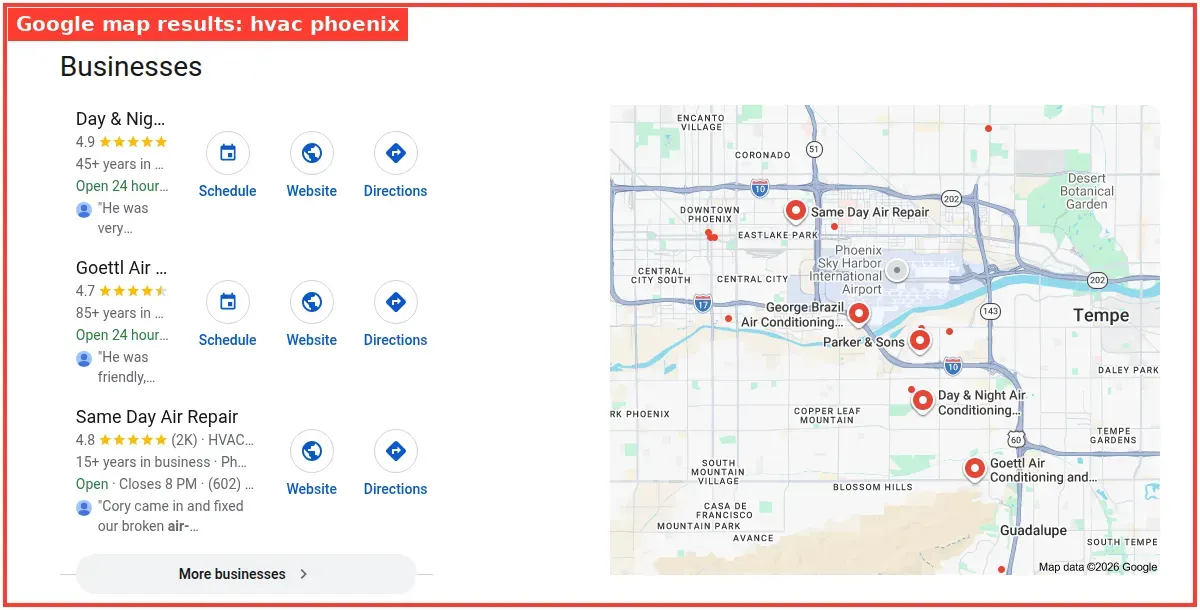
Those three map results get a big share of the calls. They depend mostly on your Google Business Profile, your reviews and how close you are to the person searching. Your website backs them up by confirming the same name, address, phone and services.
Pages we usually plan for a Phoenix service business
| Page | Why it earns its place |
|---|---|
| Home page | Your main service, your part of the Valley, your phone number and reviews |
| One page per main service | Each service can rank on its own, like "ac repair" or "water heater replacement" |
| Emergency or same-day page | For the July calls that can't wait |
| Service area pages | Only for areas with real searches, such as Scottsdale or Chandler |
| Spanish version of key pages | If many of your customers prefer Spanish |
| About and reviews | Who you are, your license and why people trust you |
The calculator checks the searches for your trade in Phoenix and suggests how many of these you need. Each page beyond the base costs $15, up to the $630 cap.
Real growth from a site built this way
This is real Search Console data from one of our client sites, with the name hidden. That client isn't in Arizona, so we don't promise the same numbers in Phoenix. It shows what happens when a site is planned around the searches people actually make.
Phoenix, Scottsdale or the East Valley?
Many Phoenix businesses work across several cities. Each one is a separate search market with its own competitors. A roofer based in Mesa that wants work in Scottsdale needs a page about Scottsdale, written for Scottsdale homes. Copying the Mesa page and swapping the name doesn't work. We write each area page separately and only for the areas you can serve well.
- Your service area is listed by name, not just "the Valley"
- Your phone number works with one tap on every page
- Your ROC license number is shown if your trade needs one
- Your business name, address and phone match your Google Business Profile exactly
- Photos are from your own jobs in the Phoenix area
- Pages load fast on mobile data, since many visitors are in a truck or a parking lot
Mistakes we see on Phoenix business websites
- "Serving the Greater Phoenix Area" and nothing else. It tells Google and customers almost nothing about where you really go.
- Winter photos and winter offers in June. Seasonal businesses should rotate the top of the home page with the season.
- A form instead of a phone number for urgent trades. Nobody with a dead AC in August fills out a five-field form.
- Hiding prices completely. A starting price or a free-estimate promise near the top earns more calls than "contact us for pricing".
- Duplicate pages for every suburb. Twenty near-identical pages make the whole site look thin.
Who you're competing with online
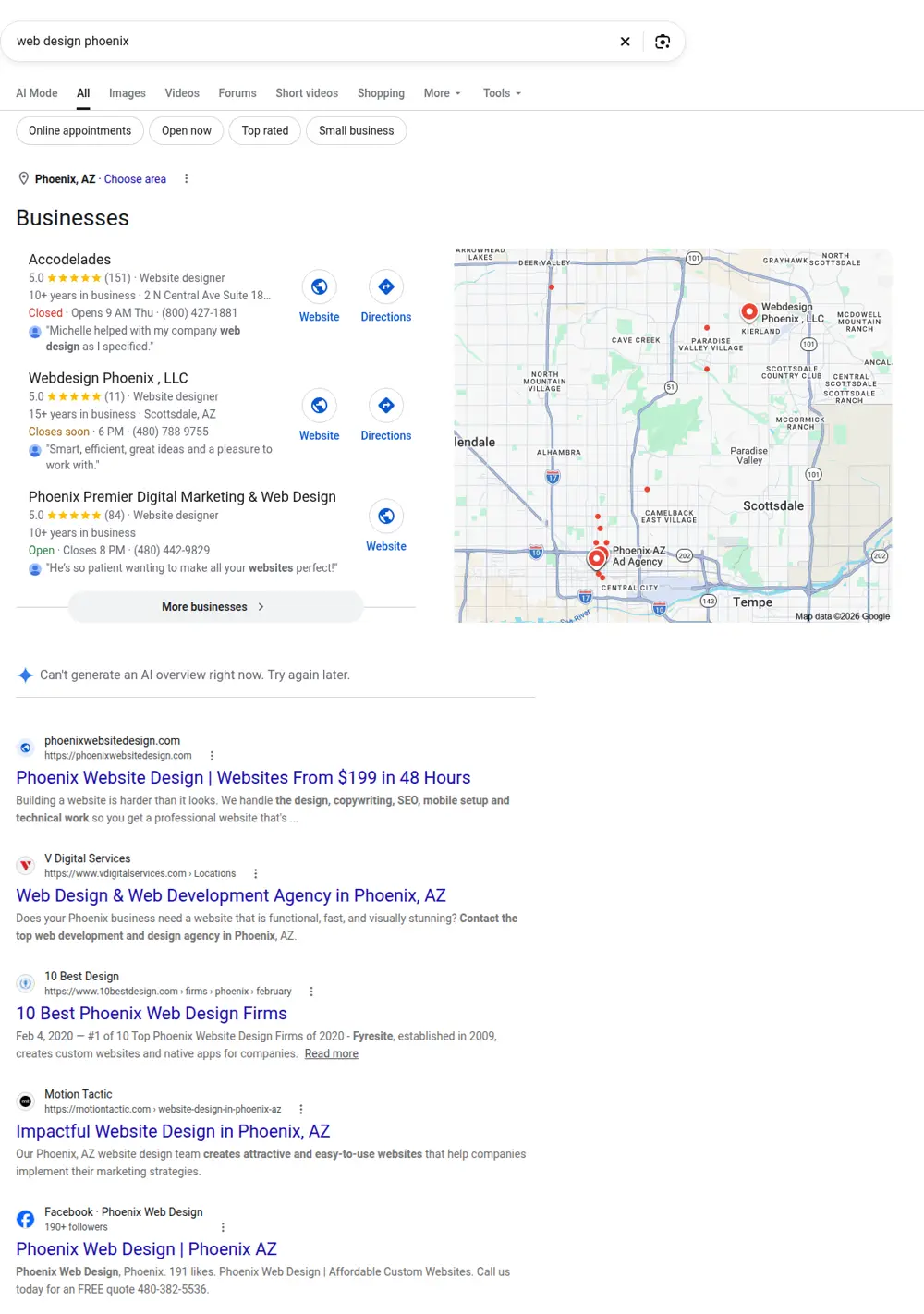
For "web design phoenix", the top results are agencies, directories and review platforms. Your customers see the same mix when they search for your trade: national lead-selling sites, review directories and a handful of local businesses with strong sites. You don't have to beat the directories for the city-wide search. You need to win the searches in your part of the Valley, with pages that answer what a customer there wants to know, and a Google Business Profile with steady reviews.
How the project works
- Run the calculator with your trade and Phoenix. You see local searches and the pages it suggests.
- Tell us your real area. We check demand in each part of the Valley you cover.
- We write and design the pages, using your photos and the details you send.
- You review a draft, ask for changes and we launch.
- We connect your Google Business Profile and check that your details match everywhere.
What a Phoenix website costs with us
The price is the same as anywhere else: $299 for the base site, $15 for each extra page and a $630 cap. Phoenix businesses that cover several cities tend to land in the middle of that range. If you're comparing quotes, our guide on how much a website costs explains what drives the price. For trade-specific ideas, see HVAC website design or web design for plumbers.
Picking among web design companies in Phoenix
Search "web design company Phoenix" and you get pages of agencies, directories and firms from Scottsdale to Chandler. A big web design firm in Phoenix AZ is built for brands with marketing teams. A plumber or roofer in the Valley needs less: pages for the areas they cover, a phone number that works with one tap, and a price that doesn't change halfway through.
Before you sign with a web design agency in Phoenix, ask three things. Will the site have its own pages for places like Mesa, Gilbert and Glendale? Is the quote a fixed number? Will the domain be in your name? If any answer is vague, keep looking.