How buyers find a manufacturer
Industrial buyers don't browse. An engineer needs a part machined to a tight tolerance, or a buyer needs a second source for sheet metal enclosures, and they search for exactly that: the process, the material, sometimes the certification and the region. They open a handful of manufacturing company websites, check whether each one can do the job, and send RFQs to two or three.
If your website doesn't say clearly that you can do the work, you're not on that list, no matter how good your shop is.
| What people type into Google | US searches per month |
|---|---|
| manufacturing website design | 390 |
| manufacturing website | 1,300 |
| best manufacturing website | 110 |
| manufacturing website design agency | 90 |
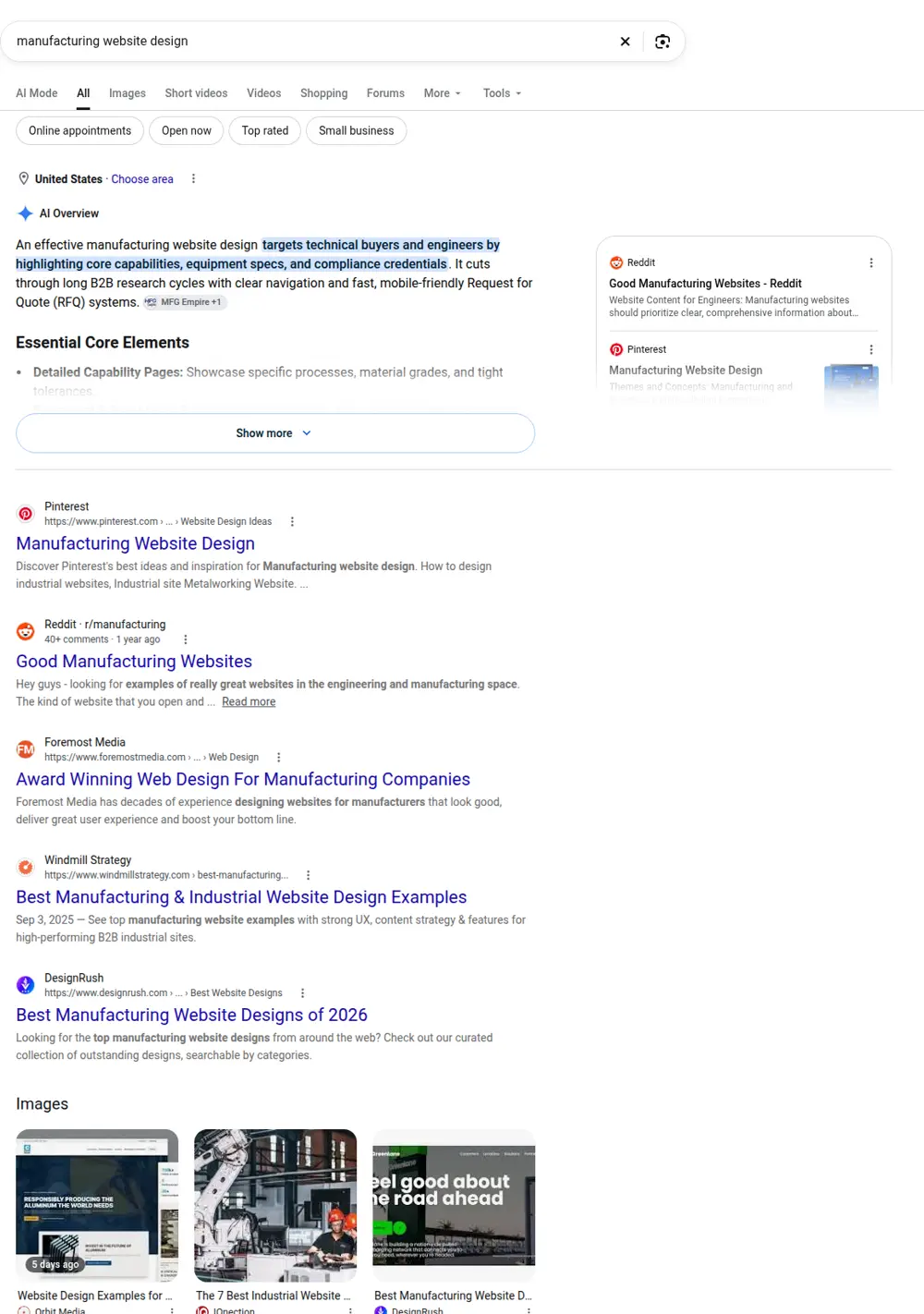
"Manufacturing website" gets about 1,300 searches a month, and "manufacturing website design" about 390. "Website design for manufacturing companies" and "manufacturing company website design" also get about 390 each. Smaller searches like "best manufacturing website" (about 110), "manufacturing website design agency" and "manufacturing company website" (about 90 each) round out the list, per DataForSEO.
Who visits a manufacturing website
Engineers. They care about capability: processes, tolerances, materials, part sizes and finishing. They want facts, not adjectives, and they often look for an equipment list.
Buyers and procurement. They care about reliability, lead times, certifications, capacity and whether you can handle their volumes. They may be qualifying you as a new supplier.
Quality managers. They check certifications like ISO 9001, AS9100, ISO 13485 or IATF 16949, inspection equipment and quality processes.
Job seekers. Skilled machinists, welders and technicians are hard to find. Your website is part of recruiting.
A good manufacturing website gives each of them a fast path to what they need.
Pages a manufacturing website needs
Capabilities
One page for each main process: CNC machining, turning, milling, sheet metal fabrication, laser cutting, welding, stamping, injection molding, assembly, finishing. Each capability page should include:
- What the process is good for, in a sentence or two
- Materials you work with
- Part size range and tolerances you hold
- Typical volumes, from prototypes to production
- Secondary operations and finishing
- Photos of real parts you've made (with customer permission)
- A link to request a quote
These pages bring in most search traffic, because engineers search by process.
Equipment list
A simple list of your machines with make, model, axes, travel or bed size and quantity. It sounds dry, but engineers trust it more than any marketing text. Update it when you add equipment.
Industries served
Aerospace, medical, automotive, defense, energy, food processing, electronics, agriculture. A page for each industry where you have experience, explaining the parts you make, the standards you meet and the challenges you understand. Buyers want a supplier who knows their world.
Quality and certifications
Your certifications with dates or certificate numbers, your inspection equipment (CMMs, optical comparators, surface testers), your quality process and documentation you can provide, like first article inspection reports or material certifications. A downloadable certificate saves the buyer an email.
Request for quote
The most important form on the site. It should accept drawings and CAD files (PDF, STEP, IGES, DXF), and ask for material, quantity, required delivery date and any certifications. Say how quickly you reply to RFQs. If your shop handles confidential drawings, mention that you'll sign an NDA.
About
Your history, facility size, location, number of employees and what makes your shop different. Photos of the shop floor and your team. Family-owned or veteran-owned manufacturers should say so.
Careers
Open positions, pay ranges if you can share them, shifts, benefits and training programs. Photos of real people at work help a lot. Many skilled workers look at a shop's website before applying.
Photos that sell manufacturing work
Most manufacturer websites use stock photos of sparks and generic robots. Engineers notice. Real photos of your parts, machines and team are far more convincing, even if they're taken on a phone. A few tips:
- Photograph parts on a clean, neutral background with good light.
- Show scale with a hand or a ruler.
- Take a wide shot of the shop floor when it's tidy.
- Get photos of people at their machines, with permission.
- Always check that parts don't reveal a customer's confidential design.
Technical content that ranks
Manufacturing searches are often long and specific: "5-axis CNC machining titanium", "aluminum sheet metal enclosures", "medical device contract manufacturing". Pages that answer those specific needs rank better than a general "services" page. Short technical articles also help, like guides on choosing between machining and casting, material comparisons or design tips that reduce cost. Engineers appreciate useful content, and it shows expertise.
Contract manufacturers and OEMs
Contract manufacturers and job shops sell capability and capacity. Their websites should focus on processes, equipment, industries and RFQs.
OEMs with their own products need product pages, specifications, distributor or dealer locators and support resources. If you sell through distributors, add a "where to buy" page and a portal or contact for dealers.
Many manufacturers do both. In that case, separate the two clearly: one section for your products and one for contract services.
Manufacturing website design vs an engineering firm site
Engineering firms sell design and expertise. Manufacturers sell production. If you offer both, for example design-for-manufacturing and production, give each its own section. Our page on engineering website design covers sites for engineering firms.
What the best manufacturing websites have in common
When we look at the best manufacturing websites in competitive niches, a pattern stands out. They put the capabilities in the main menu. Every capability page lists real specs. There's an equipment list and a certifications page. The RFQ form is short, accepts files and is linked from every page. Photos are of the real shop. And the site loads fast, even on older office computers and on phones in the plant.
None of this requires a big agency budget. It requires accurate information and a clear structure.
Common mistakes on manufacturing websites
- A homepage slider of stock images with slogans like "precision, quality, excellence".
- No capability details, only a list of process names.
- No equipment list.
- An RFQ form that doesn't accept files.
- Certifications mentioned but not shown or dated.
- A news page last updated years ago.
- PDF brochures as the only source of information.
Manufacturing website templates
A manufacturing website template can give a small shop a clean start. Most templates are designed for generic corporate businesses, though, and don't include capability pages, equipment lists or file uploads. If you use one, add those elements first. They matter more to buyers than design.
Lead times, capacity and responsiveness
Buyers often choose a supplier who answers quickly and gives realistic lead times. Your website can set expectations: typical lead times for prototypes and production, how fast you respond to RFQs and whether you offer expedited work. If you have spare capacity on certain machines, say so. It's a reason to call now.
Supplier qualification documents
When a buyer is adding you as a supplier, they need documents: W-9, certificates, insurance, quality manual summary, line card, capabilities statement. A "supplier information" page with downloadable files speeds up onboarding and shows you're organized. Keep the files current, because outdated certificates create doubts.
Line cards and capability statements
Many buyers like a one-page summary they can save or share. A downloadable line card or capability statement with your processes, materials, certifications, equipment highlights and contact details is easy to produce from the website content. Government and defense buyers especially expect a capability statement with your codes and registrations.
Trade shows and distributors
If you exhibit at trade shows, add upcoming shows to the site with booth numbers and a link to book a meeting. After each show, a short follow-up page with the products or capabilities you showed helps people you met remember you. If you work with distributors or reps, a page listing territories and contacts helps buyers find the right person.
Case studies for manufacturers
A capability page says what you can do. A case study shows that you've done it. Short project stories work well for manufacturers, even when the customer can't be named:
- The challenge. A medical device company needed a stainless part with a tight tolerance and a fast first article.
- What you did. Fixturing, programming, inspection and any design-for-manufacturing suggestions that saved cost.
- The result. Lead time, scrap rate, cost savings or the move from prototype to production volumes.
- Photos. The part, if cleared, or the process.
Three or four case studies across your main industries give buyers a concrete picture of what working with you is like.
Prototyping and low-volume work
Many engineers start with a prototype and move to production with the same supplier if the first order goes well. If you take prototype and low-volume work, give it a page. Explain minimum quantities, typical turnaround, whether you can work from a 3D model without a full drawing and how you hand off to production. This catches early-stage searches from startups and R&D teams that may become large accounts.
Serving buyers in other regions and languages
Some buyers look specifically for domestic suppliers to shorten supply chains. If that's you, say so on the home page and on each capability page: where you're located, which regions you ship to, and typical shipping times. If you export or serve customers in Mexico, Canada or Latin America, a Spanish or French version of the key pages can open new markets. We can build bilingual sites with the same structure in both languages.
Sustainability and safety
Larger customers increasingly ask suppliers about safety records, environmental practices and materials. A short page describing your safety program, recycling of scrap and coolant, energy efficiency projects and any environmental certifications answers those questions before they appear on a supplier questionnaire. Keep it factual. Buyers respond to specific practices, not green slogans.
Connecting your systems
Most small and mid-sized manufacturers don't need their website connected to their ERP. A clean RFQ form that sends files and details to the right email, with a copy in a shared folder, covers most needs. If you have a customer portal for order status or document downloads, we link to it from the header so existing customers can find it quickly.
Making the RFQ process feel safe
Engineers hesitate to upload drawings to an unknown shop. A few signals make it easier. Explain who sees the files and how they're stored. Offer to sign an NDA before receiving drawings, with a downloadable mutual NDA if you have one. Say what happens after the RFQ is submitted: a confirmation email, a named estimator, a response time and whether you'll call with questions. When the process is clear, more buyers send the drawing instead of just an email asking for capabilities.
Writing for engineers and buyers at the same time
Engineers want specs and buyers want reliability, and the same page can serve both. Lead each capability page with a short summary for buyers: what you make, for which industries, at what volumes and lead times. Follow it with a technical section for engineers: materials, tolerances, part envelope, surface finishes and inspection. A short table works well for the technical details, because engineers scan for numbers. Ending each page with the RFQ link means either reader can act as soon as they're convinced.
Keeping the site accurate
Manufacturing websites lose trust when details fall out of date: a sold machine still on the equipment list, an expired certificate, a former employee as the RFQ contact. Set a simple routine. Once a quarter, someone checks the equipment list, certifications, contacts and lead times. We make those pages easy to edit so the update takes minutes.
Real Search Console data
This is from a service business site we built. It shows traffic growing after launch as each service page starts to rank. Capability pages on manufacturing sites work the same way, each one targeting a specific process.
How we build your manufacturing website
Plan. You price the site with the calculator. We list your processes, industries and certifications and decide which deserve their own pages.
Collect. You send your equipment list, certifications, part photos (cleared with customers) and notes on tolerances and materials. An engineer or shop manager reviewing a short questionnaire is usually enough.
Write and build. We write every page in clear technical language, design the site and set up the RFQ form with file uploads.
Review and launch. Your team checks the specs for accuracy. We launch, connect Google Search Console and make sure RFQs reach the right inbox.
Price
The base is $299 and each extra page costs $15. The total is capped at $630. A job shop with six capability pages, four industry pages, an equipment list, quality and careers has thirteen extra pages: $299 + $195 = $494.