How clients look for a therapist
"Therapist near me" gets about 368,000 searches a month in the US. Many people also search with their city or with what they need help with, like "anxiety therapist" or "couples counseling". Here's the monthly volume for "therapist" plus large US cities:
New York leads at 5,400 monthly searches, with Chicago and Austin at 3,600 and Houston at 2,900. Behind these are many more searches for specialties and approaches. A therapy practice site should have pages that match them.
| What people type into Google | US searches per month |
|---|---|
| therapist website | 1,900 |
| therapist website design | 390 |
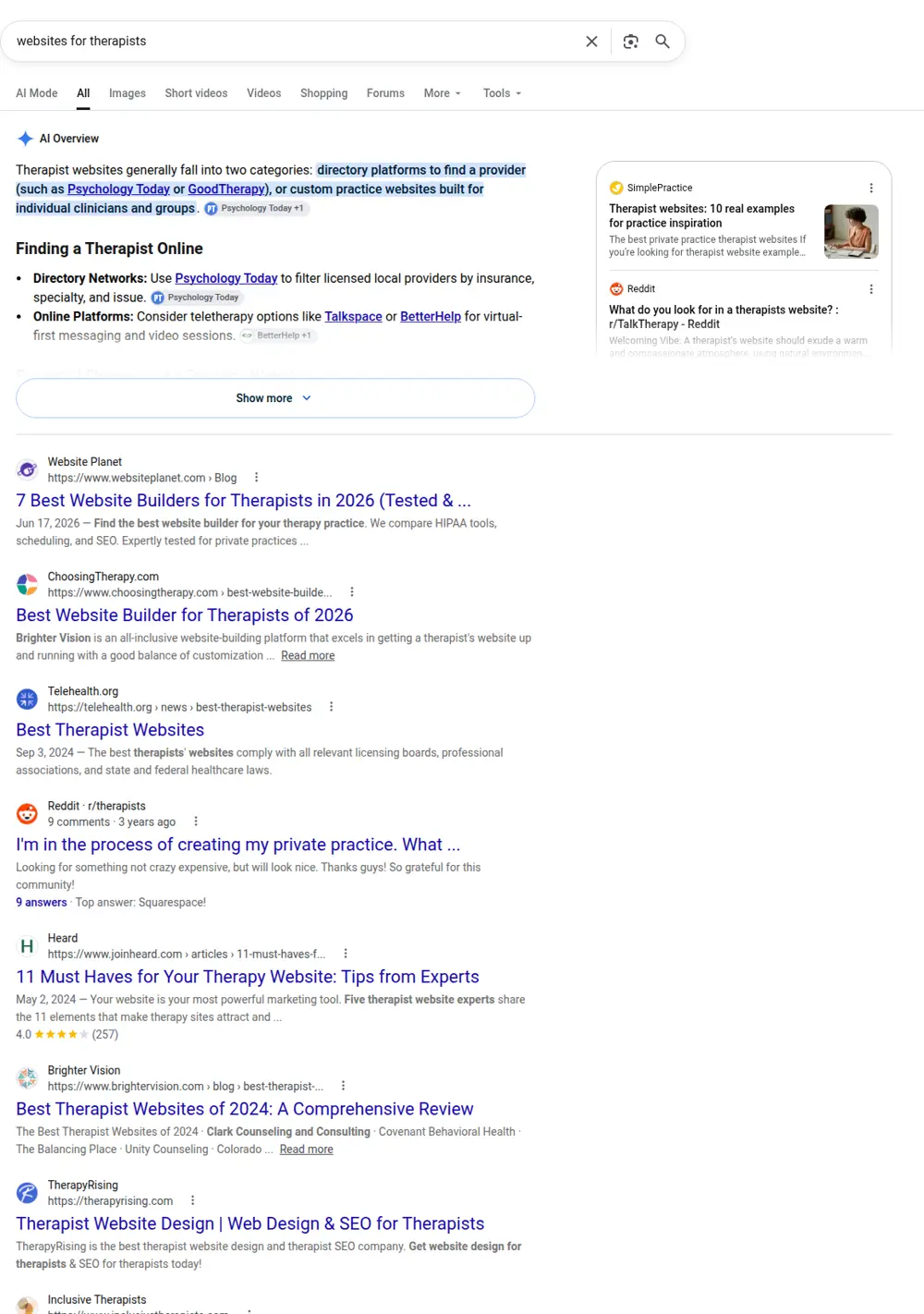
What ranks on Google for "websites for therapists"
Here are the first organic results Google showed us for "websites for therapists" (October 2026, via DataForSEO):
| # | Site | Page title | Type |
|---|---|---|---|
| 1 | websiteplanet.com | 7 Best Website Builders for Therapists in 2026 (Tested & ... | List or ranking |
| 2 | choosingtherapy.com | Best Website Builder for Therapists of 2026 | List or ranking |
| 3 | privatepracticeelevation.com | Private Practice Elevation: Therapist Website Design & Online ... | Company or service page |
| 4 | reddit.com | I'm in the process of creating my private practice. What ... | Directory, forum or social |
| 5 | telehealth.org | Best Therapist Websites | List or ranking |
| 6 | brightervision.com | Best Therapist Websites of 2024: A Comprehensive Review | List or ranking |
Therapist website results are mostly reviews of website builders and lists of best therapist sites, plus one specialist agency and a Reddit thread. Many therapists start with a builder. The specialty pages and fee details described here apply on any builder.
Why a therapist needs a website, not just a directory profile
Directories like Psychology Today are useful, and many clients find therapists there. But on a directory you're one of dozens of profiles on the same page, and the directory owns the relationship. Your own website lets you:
- Explain your approach in your own words, at the length it deserves
- Show up for searches about the specific issues you treat
- Answer the questions clients are nervous to ask, like fees, what the first session is like and whether you take insurance
- Keep working even if a directory changes its prices or rules
The two work best together. Your directory profile can link to your site for people who want to know more.
What people want to know before they reach out
Reaching out to a therapist is hard for many people. A good site lowers that barrier by answering these questions before they're asked:
- Can you help with my situation? Clear pages for the issues and populations you work with.
- What's your approach? CBT, EMDR, psychodynamic, family systems or whatever you use, explained in plain words.
- Who are you? A real photo, your training, your license and a little about why you do this work.
- What does it cost? Your fee, whether you take insurance, whether you offer superbills or a sliding scale.
- How does it work? In person, telehealth or both, session length, how often.
- How do I start? A free consultation call, an online scheduler or a simple contact form.
Pages most therapy practices need
| Page | What goes on it |
|---|---|
| Home | Who you help, where you practice, a warm intro and a clear way to reach out |
| Specialty pages | Anxiety, depression, trauma, couples, teens, grief, or whatever you focus on |
| Approach | The methods you use and what sessions feel like |
| About | Your training, license, photo and a short personal note |
| Fees and insurance | Rates, insurance, out-of-network benefits, sliding scale |
| Telehealth | How online sessions work and which states you're licensed in |
| FAQ | First session, confidentiality, cancellations |
| Contact | A simple form, phone and scheduler link |
Writing specialty pages that feel human
A specialty page shouldn't read like a textbook. It should sound like you talking to someone who is struggling. A useful structure:
- Describe the experience in the words clients use, like "Your mind won't stop racing at night", rather than clinical terms alone.
- Explain how therapy can help, and what working with you looks like.
- Mention your training in this area.
- Be honest about what to expect, including that progress takes time.
- Offer a gentle next step, like a free 15-minute consultation.
Avoid promising outcomes. Professional codes and state licensing boards generally discourage claims you can't support, and clients trust honesty more than guarantees.
Privacy, confidentiality and contact forms
Clients may share sensitive details in a first message. A regular website contact form and email aren't designed for protected health information. We keep the contact form short, asking for a name, a way to reach them and a preferred time, and add a note asking people not to share clinical details there. For intake, scheduling and messaging, we link to your secure practice management system, such as the client portal in your EHR.
We're not your compliance advisor. Check your obligations under HIPAA and your license with them. Our role is to make sure the website itself doesn't invite risk.
Telehealth and licensing across states
Therapists are generally licensed by state, and telehealth usually follows the client's location. Your site should say which states you can see clients in. If you're part of an interstate compact, such as the Counseling Compact or PSYPACT for psychologists, explain what that means in simple terms, and only list states you're actually authorized in.
Showing up in local search

That's the map pack for "therapist near me" searched from Chicago. Practices in the map get many of the inquiries. Map visibility depends mostly on your Google Business Profile, reviews and distance. Some therapists prefer not to collect reviews because of confidentiality, which is a valid choice. In that case, a complete profile, a clear website and specialty pages matter even more.
A note on reviews
Many professional codes discourage soliciting testimonials from current clients, because of the power imbalance and confidentiality concerns. We don't build review sections for therapists unless you've confirmed it fits your professional guidelines. Instead, we let your writing, credentials and approach do the work.
How a calm website looks
Design matters here. Clients arriving at a therapy site are often anxious. We use:
- Soft, readable colors and plenty of white space
- A real, friendly photo near the top
- Short paragraphs and clear headings
- No pop-ups, countdown timers or pushy sales language
- One gentle call to action per page, like "Schedule a free consultation"
Mistakes we see on therapist websites
- Only clinical language. Clients don't search for "generalized anxiety disorder treatment modalities". They search for "help with anxiety".
- No fees listed. Many people won't reach out if they can't see the cost.
- Not saying which states you serve online. It wastes everyone's time.
- Contact forms asking for symptoms or history. Keep that for your secure intake system.
- A stock photo instead of you. Clients want to see who they'll talk to.
Real Search Console data
That's real Google Search Console data from one of our client sites, with the name hidden. It isn't a therapy practice. We share it as an example of the approach.
Group practices
If you run a group practice, each clinician should have their own page with a photo, specialties, approach, license and availability. Clients often choose a clinician, not a practice. A "find the right therapist" page that groups clinicians by specialty helps people choose without calling.
How we build your therapy website
- Run the calculator with "therapist" and your city.
- Send us your specialties, approach, fees, insurance details, states you're licensed in and a photo.
- We write the pages in warm, plain language, and you edit anything that doesn't sound like you.
- We build a calm, fast site with your scheduler or portal linked.
- You approve, we launch, and we connect your Google Business Profile.
Therapist searches by city
Monthly searches for "therapist" plus a city, from DataForSEO:
| Search | Searches a month |
|---|---|
| therapist new york | 5,400 |
| therapist nyc | 5,400 |
| therapist austin | 3,600 |
| therapist chicago | 3,600 |
| therapist houston | 2,900 |
| therapist philadelphia | 2,400 |
| therapist dallas | 1,900 |
| therapist los angeles | 1,900 |
| therapist san antonio | 1,900 |
| therapist san diego | 1,900 |
| therapist phoenix | 1,300 |
| therapist indianapolis | 880 |
| therapist near me | 368,000 |
"Therapist near me" is one of the largest local searches we've seen. People also search by specialty and city: "anxiety therapist", "couples therapist", "EMDR therapist". Specialty pages on your site are how you meet those searches.
What therapists search for when they want a site
| Search | Searches a month |
|---|---|
| therapist website | 1,900 |
| therapist website design | 390 |
| best therapist website | 320 |
| therapist website templates | 260 |
| massage therapist website | 260 |
| therapist website examples | 210 |
| therapist website builder | 70 |
| physical therapist website design | 70 |
Example page plans by type of practice
| Practice | Pages that usually fit |
|---|---|
| Solo counselor | Anxiety, depression, trauma, couples, fees and insurance, first session, telehealth |
| Group practice | Each clinician, each specialty, each office, careers |
| Child and family therapist | Child therapy, teen therapy, parenting support, family therapy |
| Massage therapist | Each massage type, pricing, booking, gift cards, what to expect |
| Physical or occupational therapist | Conditions treated, insurance, referrals, first visit |
A specialty page outline
- Who this is for. Describe what the person may be feeling, in their words.
- How you help. The approaches you use, explained plainly.
- What sessions look like. Length, frequency, in person or online.
- Fees and insurance. Or a link to that page.
- Next step. One clear way to reach out.
Fees, insurance and the good faith estimate
Clients want to know cost before they call. List your fee per session, whether you take insurance or offer superbills, and any sliding scale. Under the No Surprises Act, providers generally must give self-pay clients a good faith estimate; a short note on your fees page about how you provide it helps set expectations. Check current rules for your license and state.
The first-session page
A page explaining what happens before and during the first session lowers the barrier to reaching out: how to book, what forms come first, how long it lasts, what you'll talk about, and how to cancel. Many people never contact a therapist because they don't know what to expect.
Telehealth across state lines
If you offer telehealth, say clearly which states you're licensed in. Clients often don't know that therapists generally can only see clients located in states where they're licensed, and a simple list avoids disappointment. If you're part of an interstate compact that applies to your profession, mention it and link to the compact's official site so clients can check.
Specialty pages people search for
People often search for a type of therapy or a specific concern plus their city. Common examples include anxiety, depression, trauma, couples counseling, grief, ADHD, postpartum support and EMDR. A separate page for each specialty you actually practice, written in plain language, meets those searches better than one long list. Each page should explain who it's for, what sessions look like and how to take the first step.
Directory profiles and your own site
Directory profiles bring inquiries, and many therapists rely on them. Your own website complements them: it's where people go to learn more after finding you in a directory, and it can rank on its own for specialty and city searches. Link your directory profile to your site, keep details consistent across both, and use your site for the depth that a profile can't hold.
Writing in a calm, human voice
Therapy websites work best when they sound like the therapist. Short paragraphs, warm but direct language, and no jargon. Speak to what the reader may be feeling, then explain how you help. Avoid long lists of credentials at the top; put them on the about page, where people who want them will look.
Insurance and out-of-network pages
Many clients choose a therapist based on insurance. If you're in-network with specific plans, list them. If you're out-of-network, explain what that means in plain language: the client pays your fee, you provide a superbill, and they may be reimbursed depending on their plan. Suggest questions they can ask their insurer. A clear insurance page answers one of the most common reasons people hesitate to reach out.
Accessibility and comfort
Some visitors to therapy websites are anxious or overwhelmed. Clear navigation, readable font sizes, enough contrast, and short pages help everyone. Avoid autoplay video and pop-ups. Make the contact option easy to find without being pushy: one calm button that says what happens next, like "Book a free 15-minute call", if you offer one.
Group practice pages
For group practices, a page for each clinician with their photo, specialties, approach, availability and fees helps clients choose. A short matching section, like "Not sure who to see? Tell us a bit and we'll suggest someone", reduces hesitation. Keep each clinician's page written in their own voice, and update it when availability changes.
Booking and consultations
Many therapists offer a free short phone consultation before the first session. If you do, make it the main button on the site, say how long it lasts and what you'll talk about, and link to a scheduling tool if you use one. If you don't offer consultations, explain the simplest first step instead: a short form, an email, or a call. Say how soon you usually reply and whether you have a waitlist. Clients who know what to expect are more likely to reach out, and less likely to drop off halfway.
Price
$299 base, $15 per extra page, never more than $630. Solo practices usually need 6 to 10 pages. Group practices with several clinicians need more. For related sites, see medical website design or websites for chiropractors. For general pricing, see how much a website costs.