Who visits a trucking company website
Trucking websites have three visitors. Shippers want to know if you haul their freight on their lanes and whether you're reliable. Freight brokers want to verify your authority, insurance and equipment before giving you a load. Drivers want to know about pay, home time and trucks before they apply.
A good trucking company website answers each of them quickly, and doesn't try to look like a load board.
Searches for trucking companies plus a city name are concentrated in freight hubs. Chicago leads this list with about 1,900 a month, followed by Houston at 1,000 and Dallas at 880, per DataForSEO.
| What people type into Google | US searches per month |
|---|---|
| trucking company website design | 30 |
| trucking company website | 90 |
"Trucking company website" and "websites for trucking companies" get about 90 searches a month each. "Trucking company website design" and "trucking company website template" get about 30 each, per DataForSEO. These are small numbers, but the people searching are usually owners ready to build a site.
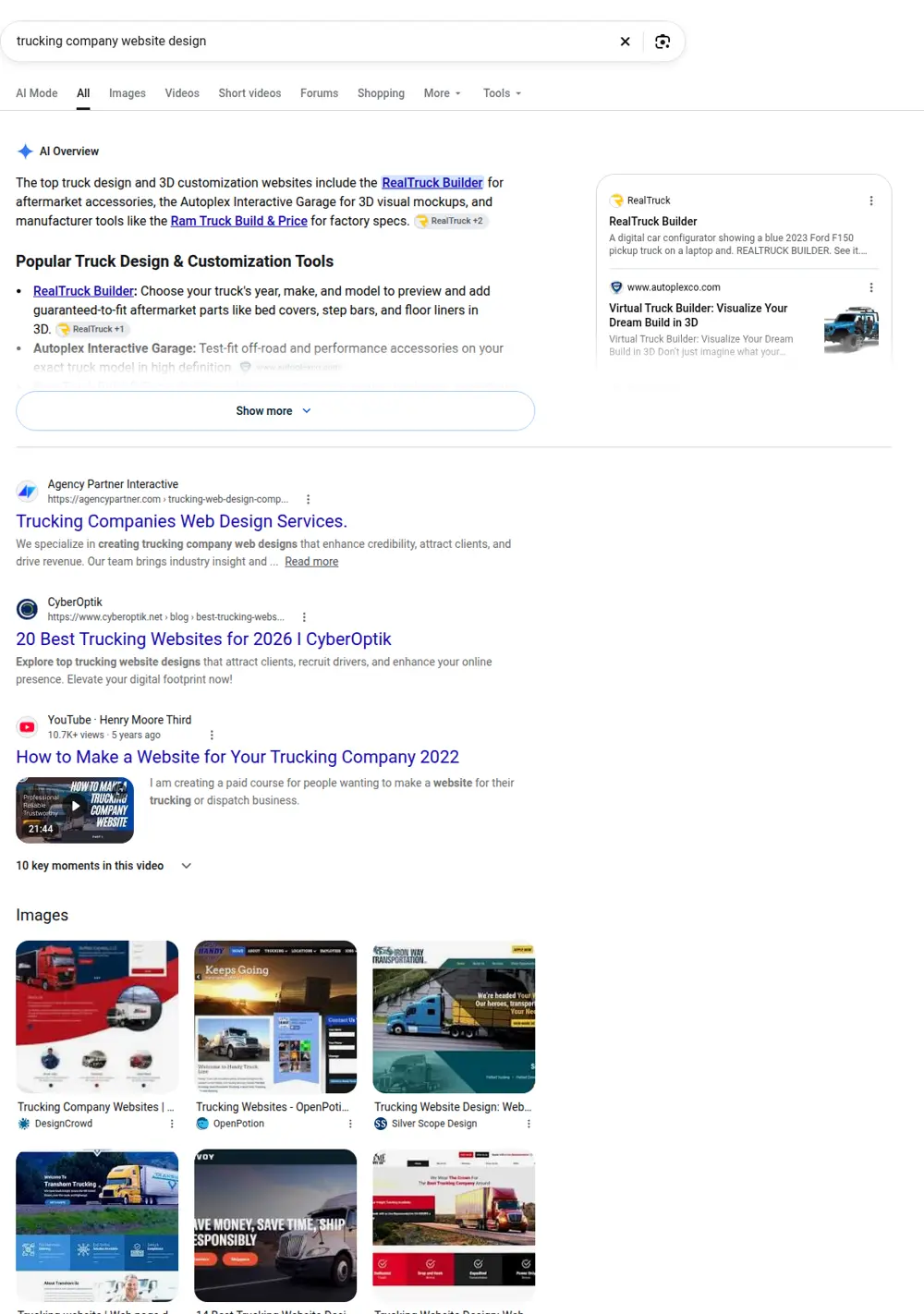
Pages a trucking company needs
Services. Dry van, refrigerated, flatbed, LTL, hazmat, dedicated, drayage, expedited. One page or section for each service you run, with equipment details.
Lanes and coverage. A map or list of the regions and lanes you run regularly. Shippers and brokers use this to decide fast.
Quote request. Origin, destination, freight type, weight, dates and contact details. Keep it short and reply quickly.
Safety and compliance. USDOT and MC numbers, insurance coverage, safety ratings and certifications. Link to the public FMCSA record so brokers can verify you.
Driver recruiting. Pay structure, home time, benefits, equipment, routes and requirements, with a short application form. For many carriers, this page brings the most traffic.
About. Your history, terminals and fleet size, with real photos of your trucks.
Driver recruiting pages that work
Driver shortages make recruiting a constant job for many carriers. Drivers compare companies quickly, often on their phones during a break. A recruiting page should answer, near the top:
- Pay: cents per mile, percentage or salary, plus any sign-on or safety bonuses
- Home time: daily, weekly or on a set schedule
- Routes: local, regional or over the road
- Equipment: truck age, make and features
- Requirements: CDL class, years of experience, endorsements
- Benefits: health insurance, paid time off, retirement
Then a short application with name, phone, CDL class and experience. You can collect the full DOT application later. A page like this, with real photos of your trucks and drivers, often outperforms paid job board listings.
Helping brokers say yes
Brokers check new carriers carefully because of fraud. Make it easy: show your MC and USDOT numbers, a link to your FMCSA record, your insurance limits, your dispatch contact with a direct phone number and the equipment you run. A downloadable carrier packet saves a round of emails. If you're an agent who insures fleets rather than a carrier, see our page on insurance agency website design.
Trucking company website templates
A trucking company website template can work for a small fleet, but most templates are generic logistics designs with stock photos of ships and warehouses. Replace those with your own trucks, add your real lanes and recruiting details and the template becomes useful.
Real Search Console data
This is from a service business site we built, showing how traffic grows as service pages start to rank.
How the project works
Start with the calculator to price the site. We agree on services, lanes and recruiting pages, and you send your DOT and MC numbers, photos of your fleet and driver pay details. We write the pages, build the site and send a draft. After approval, we launch and connect Search Console.
Price
$299 base, $15 per extra page, $630 at most. Four service pages, a lanes page, a safety page and a recruiting page is 7 extra pages, or $404.