How people choose an insurance agency
Most people don't enjoy shopping for insurance. They do it when something changes: a new car, a new house, a baby, a business opening, or a renewal notice with a higher price. They want someone who explains options simply, compares carriers for them and answers the phone when there's a claim.
That's the advantage a local agency has over a big online carrier, and your website needs to make it obvious.
Local searches for insurance agencies plus a city name are smaller than for other services but steady. Houston leads this list with about 590 a month, followed by Phoenix and San Antonio at 480 each, per DataForSEO. Many more people search for specific products like "car insurance" or "homeowners insurance" with their city.
| What people type into Google | US searches per month |
|---|---|
| insurance agency website design | 170 |
| insurance agency website development | 110 |
| insurance agency website | 90 |
| insurance agency website templates | 70 |
| insurance agency website builder | 40 |
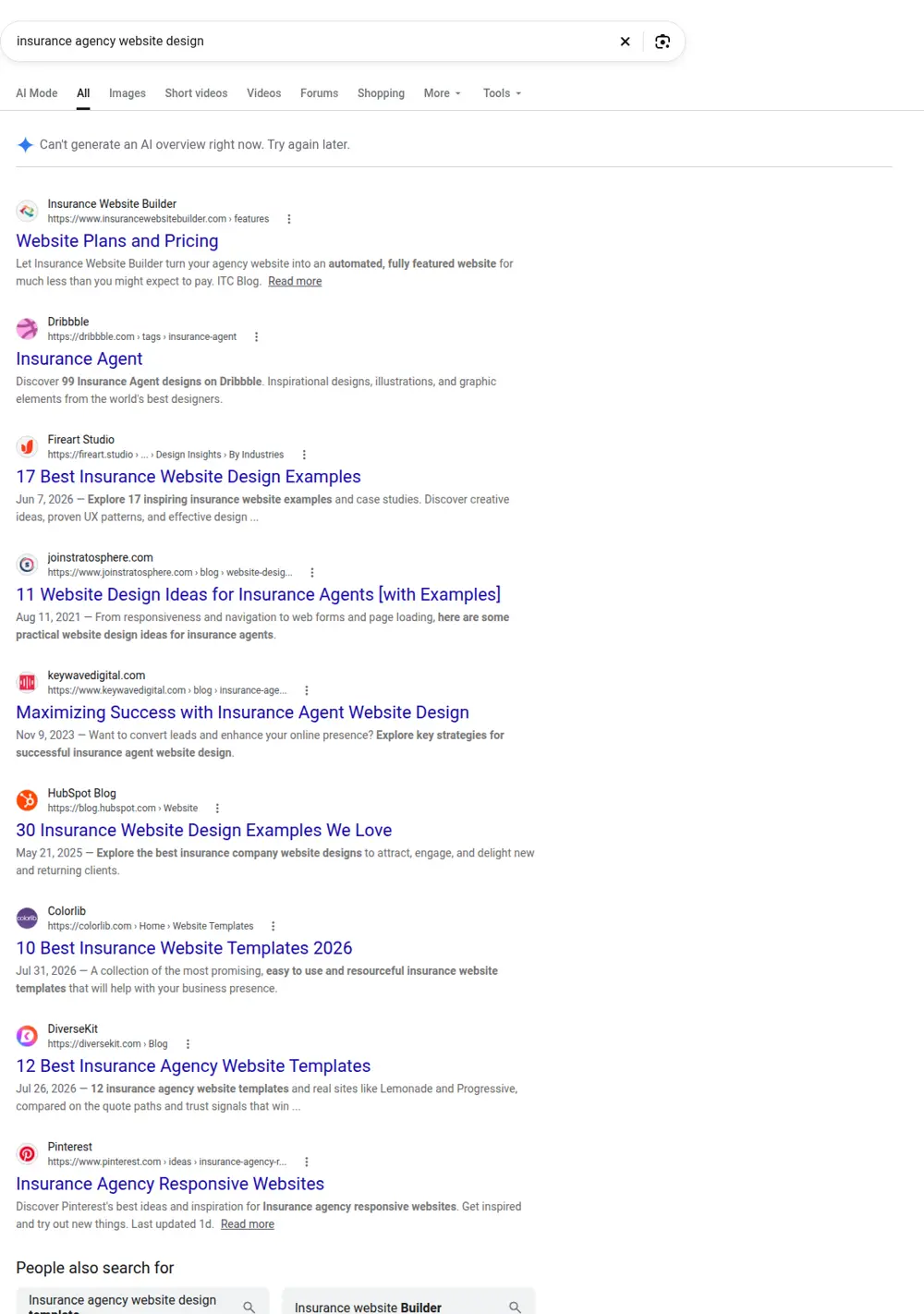
On the agency side, "insurance agency website design" and searches like "website for insurance agency" get about 170 a month each. "Insurance agency website development" gets about 110, "insurance agency website templates" about 70 and "insurance agency website builder" about 40, per DataForSEO.
What an insurance agency website needs
Product pages people can understand
Each line you write deserves its own page: auto, home, renters, life, umbrella, business, commercial auto, workers' comp, and whatever else you specialize in. Each page should explain in plain words:
- Who needs this coverage and when
- What it typically covers and what it doesn't
- What affects the price
- Which carriers you work with for it, if you can say
- How to request a quote
Avoid copying carrier brochures. People want a human explanation, not legal language.
Quote request forms
A short form for each product works better than a long, generic one. For auto, a name, phone, zip code, number of drivers and vehicles and current carrier is enough to start. You'll collect the rest on a call. Long multi-step forms lose people, especially on mobile.
Independent or captive
If you're an independent agency, say it clearly and explain why it matters: you compare several carriers and work for the client. List the carriers you represent if your agreements allow it. If you're a captive agent, focus on the carrier's strengths and your personal service.
Local pages
People prefer an agent nearby, even if most of the work happens by phone. Pages for the towns you serve, with local details like common risks (flooding, hail, wildfire), local businesses you insure and your office address, help you appear in local searches.
Claims help
A page explaining what to do after an accident or loss, with carrier claim numbers and how your agency helps, is valuable for current clients and shows prospects you'll be there when it counts.
Team and reviews
Insurance is a relationship. Show your agents with real photos, their licenses and specialties, and a few lines about each. Add reviews from clients, especially ones that mention claims handled well.
Compliance and trust
Insurance marketing has rules. Your site should show agency and agent license numbers where required, avoid promising specific savings without context and include the disclaimers your carriers or state require. We write in a way that stays clear and honest, and you or your compliance contact review the final copy before launch.
Security matters too. Quote forms collect personal details, so the site runs on HTTPS and forms send data securely. We don't ask for sensitive details like Social Security numbers on a public form.
Insurance agency website templates and builders
Insurance agency website templates and builders, including the ones some carriers offer their agents, can get you online quickly. The trade-off is that hundreds of agencies use the same text, which makes it hard to rank and hard to stand out. If you use a carrier template, add your own local pages and an "about us" with real people. If you want a site that's fully yours, that's what we build.
Business insurance pages
Commercial lines are often where agencies grow fastest, and business owners search differently. They look for coverage by industry: "contractor insurance", "restaurant insurance", "trucking insurance". If you specialize, build a page for each industry with the coverages that industry needs, typical risks and what information you need for a quote. Our page on web design for trucking companies covers the trucking side if those are your clients.
Renewal and policy review pages
Many clients only think about insurance at renewal, when the price goes up. A page inviting existing and new clients to request a free policy review, with a short form and an explanation of what you check (coverage gaps, discounts, bundling), gives people a reason to contact you at the moment they're most likely to switch. Mention it in your renewal emails and link it from the home page during busy renewal months.
Common mistakes on insurance agency websites
- Carrier logos everywhere and no information about the agency itself.
- One "get a quote" form for every product.
- Copy taken from carrier sites word for word.
- No photos of the team, or only stock photos of handshakes.
- Phone numbers that go to a general carrier line instead of your office.
Real Search Console data
This is from a local service site we built. It shows traffic building over the months after launch as each service page begins to rank. Insurance agencies with product and town pages follow a similar pattern.
How the project works
You use the calculator to price the site and see local search demand. We agree on the products and towns that deserve pages. You send your license details, carrier list and team photos, and we write the content in plain language. After you and your compliance contact approve the draft, we launch and connect Search Console and your Google Business Profile.
Price
The base price is $299. Each extra page is $15, up to a $630 maximum. An agency with eight product pages, a claims page and four town pages pays $299 plus 13 × $15, which is $494.