San Diego is a city of neighborhoods, and search follows them
San Diego has a population of over 1.4 million, making it the second-largest city in California, and the wider San Diego area has more than 3.3 million people. It sits on the Pacific coast right next to the Mexican border, and it's known for its beaches, its parks and its long connection with the US Navy.
For a local business, the useful fact is that San Diegans think in neighborhoods. A homeowner in Clairemont, a renter in Pacific Beach and a family in Rancho Bernardo all live in the city, but they look for help close to home. Your site should make it clear which of those places you serve.
What San Diego customers search for
Monthly Google searches for common local services plus "san diego":
Plumbers top the trades at 6,600 searches a month. Hair salons follow at 5,400, then dentists and house cleaning at 4,400 each. Chiropractors and real estate agents both show 3,600, which is high for the size of the city compared with what we see elsewhere. Restaurants have far more searches than any trade, so we left them out of the chart to keep the scale readable.
| What people type into Google | US searches per month |
|---|---|
| web design san diego | 880 |
The parts of San Diego people actually name
When people add a place to a search, it's usually one of these:
- Central and coastal neighborhoods: Downtown, the Gaslamp Quarter, Little Italy, Hillcrest, North Park, Ocean Beach, Pacific Beach, Mission Valley and La Jolla
- Northern areas: Clairemont, Mira Mesa, Rancho Bernardo, Carmel Valley and Scripps Ranch
- Nearby cities in the county: Chula Vista, Oceanside, Escondido, Carlsbad, El Cajon and National City
- Roads people use as reference points: I-5, I-8, I-15, I-805 and SR 163
- Landmarks: Balboa Park, the San Diego Zoo, Petco Park, Mission Bay and the Coronado Bridge
A good San Diego service area page uses these naturally. A cleaning company page for La Jolla can talk about coastal homes and salt air on windows. A plumber's page for North Park can mention the older Craftsman houses and their original pipes. These details tell customers you know the area, and they help Google understand where you work.
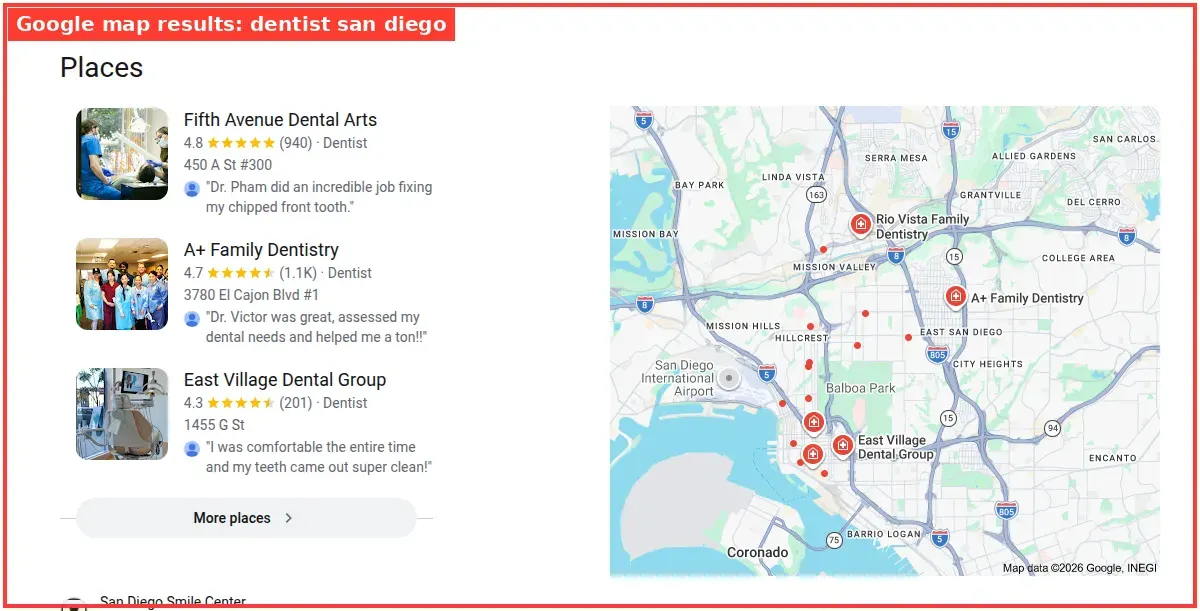
This is what a dentist search looks like from San Diego. The three businesses in the map get most of the attention, so your Google Business Profile, your reviews and your site need to tell the same story.
What a San Diego site should show first
Visitors on a phone decide in a few seconds whether to call. For most San Diego service businesses, we put these above the fold:
- Your main service and the neighborhoods you cover in the headline
- A tap-to-call button and a booking or quote button
- Your Google rating and a short review from a local customer
- Your license number if you're a contractor, since California expects it in advertising
For practices like dentists and chiropractors, online booking near the top matters more than a phone number. For trades, it's the reverse.
Spanish pages near the border
San Diego County shares a border with Tijuana, and many local customers prefer to talk about their problem in Spanish. If someone on your team can take those calls, we write Spanish versions of your main pages with their own titles and descriptions. They can then show up for Spanish searches. If no one can answer in Spanish, we leave it out, because a Spanish page that leads to an English-only phone line loses trust fast.
Pages we plan for a San Diego business
| Page type | When it's worth building |
|---|---|
| A page per service | Always, for the services you want more of |
| Neighborhood or city pages | When there are real searches there and you work there |
| Booking or quote page | When most customers want to schedule online |
| Spanish pages | When your team can take Spanish calls |
| Reviews and about page | Always, with your license and photos of your team |
A real result from a site built this way
That chart comes from Google Search Console for one of our client sites, with the name hidden. It's not a San Diego business, and every market is different, so we share it as an example of the approach rather than a promise.
Common mistakes on San Diego small business sites
- Treating the whole county as one area. Oceanside and Chula Vista are 50 miles apart and are separate markets.
- Stock beach photos. Customers can tell. Real photos of your team and your jobs earn more trust.
- No license number. It's a trust signal for customers and expected by California's contractor board.
- A slow site with an autoplay video. On a phone near the beach with weak signal, it means a lost call.
- A contact form as the only option. Many people want to call or text.
How we work with San Diego businesses
Everything happens remotely, by email and video call. That keeps the price low and means you don't lose an afternoon in traffic on the 805.
- Run the calculator with your trade and San Diego.
- Send us your service area and the jobs you want more of.
- We write the pages for each part of the county that's worth it.
- We design and build, with your photos and reviews near the top.
- You review the draft and we launch, then connect your Google Business Profile.
How to choose a web designer in San Diego
Most lists of San Diego web design companies rank agencies by awards or team size. For a small business, five plain questions tell you more:
- Do they plan pages from real searches? Ask which San Diego neighborhoods and services they would build pages for, and why. If the answer is "a home page and a contact page", your site will only show up for your own name.
- Is the price fixed and written down? A quote that says "starting at" usually grows. Ask for the full number, including hosting for the first year.
- Who owns the domain and the site? It should be registered in your name, so you can leave without losing it.
- Can they handle Spanish pages? In a border city this matters for many trades. Check whether they write them properly or just run a translator.
- Can you see live sites they built? Screenshots are easy to fake. Ask for links and check them on your phone.
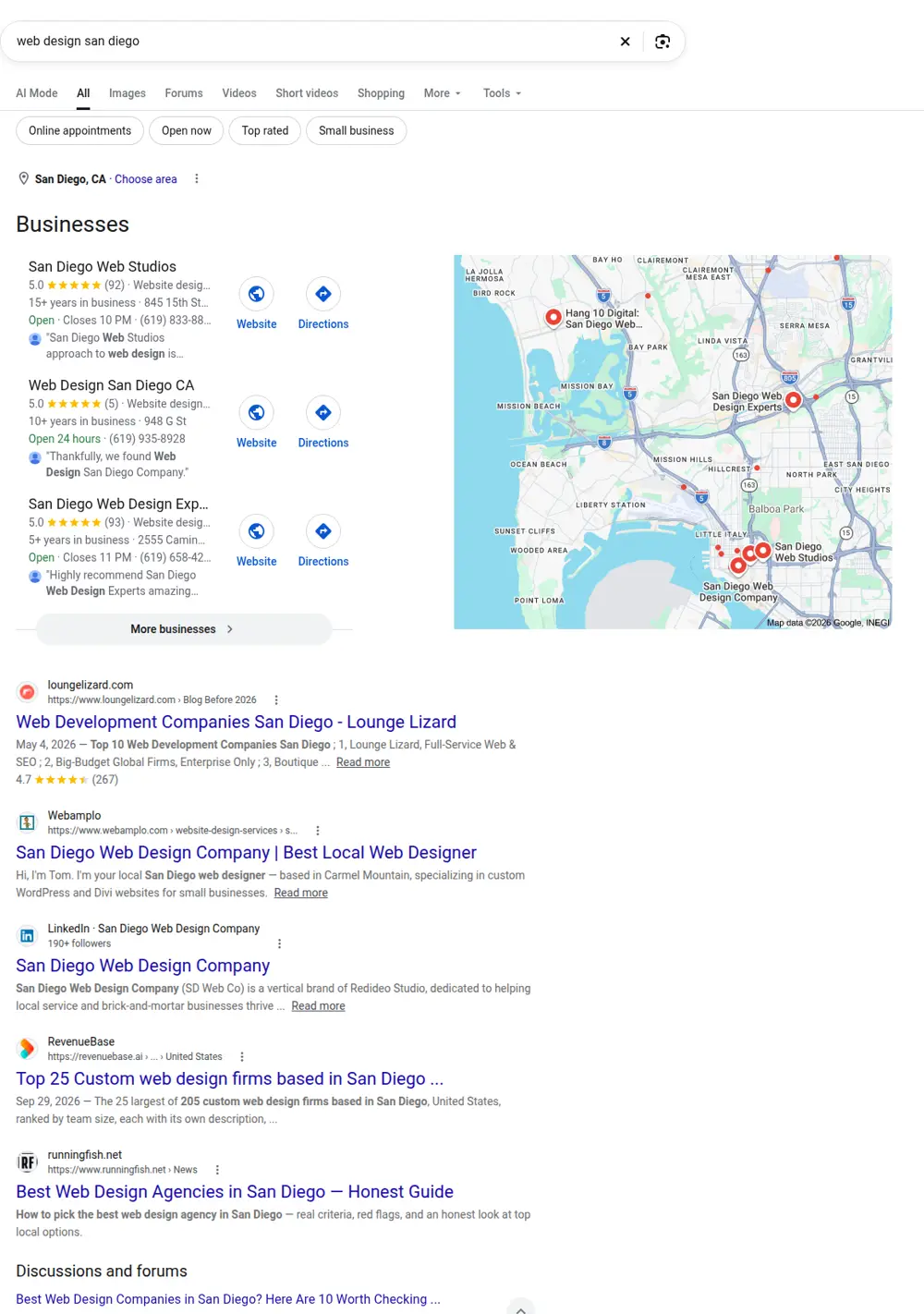
Searching for a web design company in San Diego CA turns up big agencies and small studios alike. The questions above help you compare them on what matters for a local business.
Price
Our San Diego price is the same as everywhere: $299 for the base site, $15 for each extra page, capped at $630. Businesses that serve several cities in the county usually need more pages and land closer to the cap. For statewide rules like license numbers and privacy pages, see our page on website design in California. For trade ideas, see websites for dentists or websites for salons.