How clients find a lawyer
"Lawyer near me" gets about 40,500 searches a month in the US, but that's only the start. Most people search for a specific kind of lawyer: "car accident lawyer", "divorce attorney", "DUI lawyer", plus their city. Here's the monthly volume for "lawyer" plus large US cities:
New York leads at 4,400 monthly searches, with Los Angeles and Houston at 3,600 and San Antonio and Dallas at 2,900. Practice area searches add up to far more, and they often bring clients who are ready to hire. A law firm site should have a page for each practice area that matters to the firm.
| What people type into Google | US searches per month |
|---|---|
| law firm website design | 1,600 |
| lawyer website design | 1,000 |

What ranks on Google for "web design for law firms"
Here are the first organic results Google showed us for "web design for law firms" (October 2026, via DataForSEO):
| # | Site | Page title | Type |
|---|---|---|---|
| 1 | themodernfirm.com | The Modern Firm: Law Firm Website Design & Attorney ... | Company or service page |
| 2 | dribbble.com | Law Firm Website | Company or service page |
| 3 | clio.com | 11 Best Law Firm Web Design Companies - Clio | List or ranking |
| 4 | americanbar.org | What to Keep in Mind When Designing Your Law Firm's ... | Guide or article |
| 5 | attorneyatlawmagazine.com | Best Law Firm Websites in 2026 (Top 73) | List or ranking |
| 6 | paperstreet.com | Best Websites for Law Firms: 150+ Award-Winning Designs | List or ranking |
Law firm results are crowded with award lists and "best websites" roundups, plus an ABA article on what to keep in mind. Specialized legal marketing agencies rank at the top. Their pages are long and broad; a small firm often just needs practice area pages done well.
What a law firm website needs to do
A potential client on a law firm site usually has a problem, a deadline and some fear. They want to know quickly:
- Do you handle my kind of case?
- Where are you, and do you work in my county or court?
- Who will I work with?
- What will it cost, or at least how fees work, such as contingency, flat fee or hourly?
- How do I talk to someone today?
A good law firm site answers those on the first screen and on every practice area page.
Pages most law firms need
| Page | What goes on it |
|---|---|
| Home | Your main practice areas, your city, a phone number and a consultation button |
| Practice area pages | One per area, like personal injury, family law, criminal defense or estate planning |
| Sub-practice pages | For big areas, like car accidents, truck accidents and slip and fall under injury |
| Attorney bios | Photo, bar admissions, education, experience and practice focus |
| Case results | Real results, with the disclaimers your state requires |
| Fees | How you charge, free consultations, contingency terms |
| Locations | One page per office, with directions and the courts you appear in |
| Contact and intake | Phone, form, scheduling and hours |
Practice area pages that rank and convert
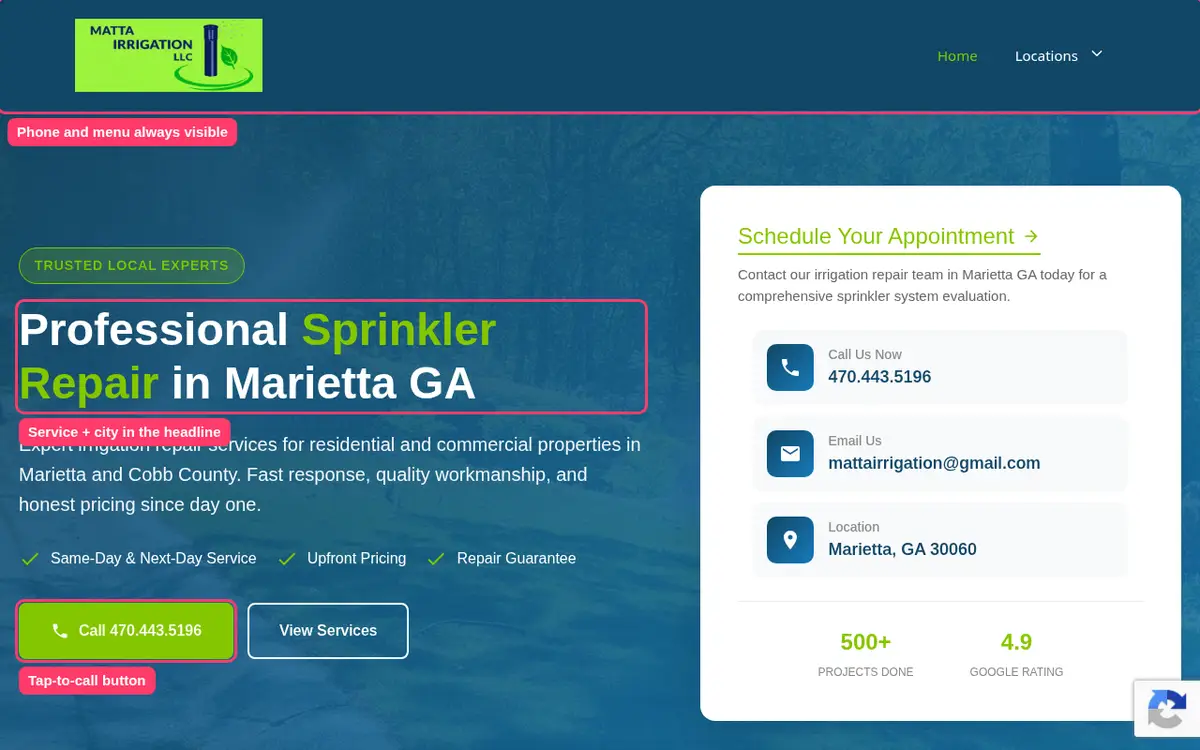
Each practice area page should do three things: show up for searches, explain the client's situation and options in plain English, and make it easy to call. A solid structure:
- Headline with the practice area and city, like "Divorce Lawyer in Tampa"
- A short summary of how you help and who you represent
- What the process looks like, step by step
- Common questions, like how long it takes and what it costs
- Why your firm, with experience and relevant results
- A call to action, with a phone number and a consultation form
Plain English matters. A client looking up "what happens after a DUI arrest" doesn't want to read a statute. They want to understand their next steps.
Legal advertising rules
Lawyer websites are advertising, and state bars regulate them. Most states follow some version of the ABA Model Rules, which prohibit false or misleading communications about a lawyer's services. Specific rules vary by state, and some are strict about:
- Words like "specialist" or "expert", which may require certification
- Case results and testimonials, which often need disclaimers that past results don't guarantee future outcomes
- Comparisons with other lawyers
- Labeling the site as attorney advertising in some states
We write conservative copy and add standard disclaimers, but the final responsibility is the firm's. You or your compliance contact should review every page before launch.
Showing up in local search
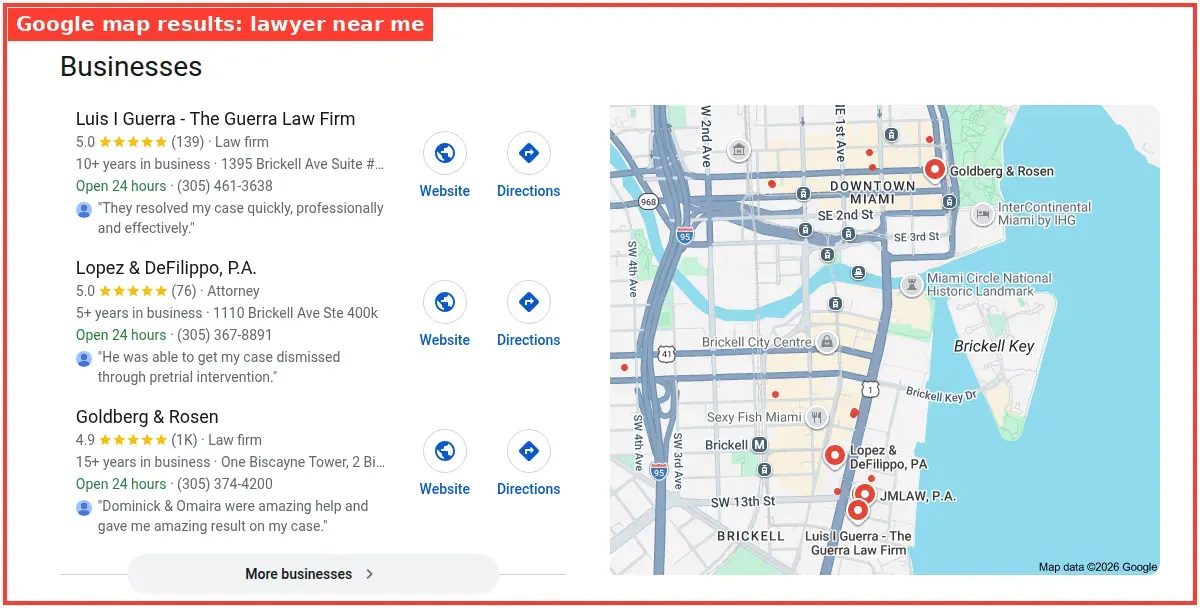
That's the map for "lawyer near me" searched from Miami. Firms in the map pack get a large share of calls. Map rankings depend mostly on your Google Business Profile, reviews and distance. For a firm with several offices, each office needs its own profile and its own location page on the site.
Competition for legal searches is fierce, and big firms spend heavily on ads and directories. A smaller firm wins by being specific: the exact practice areas, the exact cities and courts, and clear, helpful pages.
Attorney bios clients actually read
Clients hire people. A good bio has:
- A professional but warm photo
- Bar admissions and years in practice
- Education and any certifications
- The kinds of cases the attorney focuses on
- A short, human note about why they practice this kind of law
- Languages spoken
- A direct way to schedule with that attorney
Intake: don't lose the call
Many legal clients call or reach out after hours. Make sure your site shows:
- A phone number that's answered, even if it's an intake service after hours
- A short contact form asking only for name, phone, email and a brief description
- A note telling people not to send confidential details through the form until an attorney-client relationship is set up
- Response time expectations, like "we reply within one business day"
Mistakes we see on law firm websites
- One "Practice Areas" page listing everything. It can't rank for each area. Give each one its own page.
- Legal jargon everywhere. Clients search in plain English.
- Results without disclaimers. Check your state's rules.
- Stock photos of gavels and scales. Real photos of your attorneys and office build more trust.
- No fee information. Even "free consultation" and "no fee unless we win" for injury cases helps a lot.
- Slow pages. Many clients search on a phone right after something happened.
Real Search Console data
That's real Google Search Console data from one of our client sites, with the name hidden. It isn't a law firm. We share it as an example of the approach.
Firms that fit our fixed price
Our sites suit solo attorneys and small firms that need a clean, fast site with the right practice area and location pages. Large firms with dozens of attorneys, complex intake systems or heavy content marketing usually need a specialized legal marketing agency, and we'll tell you if that's you.
How we build your firm's site
- Run the calculator with "lawyer" and your city to see local searches.
- Send us your practice areas, attorneys, offices, fee structure and any case results you want to show.
- We write the pages in plain English, with conservative claims and standard disclaimers.
- You or your compliance contact review every page.
- We launch and connect your Google Business Profile.
Lawyer searches by city
Monthly searches for "lawyer" plus a city, from DataForSEO:
| Search | Searches a month |
|---|---|
| lawyer new york | 4,400 |
| lawyer houston | 3,600 |
| lawyer los angeles | 3,600 |
| lawyer dallas | 2,900 |
| lawyer san antonio | 2,900 |
| lawyer philadelphia | 2,400 |
| lawyer austin | 1,600 |
| lawyer indianapolis | 1,600 |
| lawyer phoenix | 1,600 |
| lawyer near me | 40,500 |
Most real searches are more specific: a practice area plus a city, like "divorce lawyer houston" or "dui attorney phoenix". Those are the searches a practice area page is built to win.
What firms search for when they want a site
| Search | Searches a month |
|---|---|
| law firm website design | 1,600 |
| law firm website marketing | 720 |
| top law firm website design | 320 |
| law firm website seo | 170 |
| law firm website templates | 90 |
| law firm website content writing | 70 |
| small law firm website design | 70 |
| law firm website examples | 50 |
Example page plans by type of firm
| Firm type | Practice area pages | Supporting pages |
|---|---|---|
| Personal injury | Car accidents, truck accidents, slip and fall, wrongful death, dog bites | How contingency fees work, what to do after an accident |
| Family law | Divorce, child custody, child support, adoption, prenuptial agreements | The divorce process in your state |
| Criminal defense | DUI, drug charges, assault, theft, expungement | What happens after an arrest |
| Estate planning | Wills, trusts, probate, powers of attorney | Estate planning checklist |
| Immigration | Family visas, green cards, citizenship, deportation defense | Languages spoken, consultation process |
Each practice area page can also have a version for a second city where the firm has an office or regularly takes cases, if people search that way.
Writing practice area content
Law firm content gets real searches on its own ("law firm website content writing" has 70 a month). Good practice area pages explain, in plain language, who the page is for, how the process works in your state, what it typically costs or how fees are set, and what to do next. Avoid promises about outcomes. Have a lawyer at the firm review every page before it goes live; you're responsible for what it says.
Languages
If attorneys or staff speak other languages, say so on the home page, attorney bios and contact page. For firms with many clients who speak Spanish or another language, full pages in that language can help, as long as someone at the firm can answer calls and messages in it.
Case results and testimonials
Many firms want to show case results and client testimonials, and both can help. Bar rules in many states limit how they can be presented, often requiring disclaimers that past results don't guarantee future outcomes. Check your state's rules, keep results accurate, and get client permission before publishing anything about their case.
Intake pages for each practice area
Different cases need different first questions. A personal injury intake asks about the accident date and injuries. A family law intake asks about children and whether a case is already filed. A criminal defense intake asks about charges and court dates. Short, practice-specific forms on each practice area page get more complete inquiries than one generic contact form. Say how quickly someone responds and whether the first consultation is free.
Speed and mobile
Many people look for a lawyer on their phone, often in a stressful moment. A site that loads slowly or hides the phone number loses them. Keep pages light, put the phone number and a short form near the top, and make sure the site works well on a small screen before anything else.
Multiple offices and service areas
If your firm has more than one office, give each its own page with the address, a map, parking or transit notes, hours and the attorneys who work there. Make sure each office's details match its Google Business Profile exactly. If you take cases in surrounding counties without an office there, a short page explaining the courts you appear in and how consultations work for clients there can help, as long as it's accurate.
Attorney photos and video
Clients want to see who they'll work with. Professional, natural photos of each attorney, ideally in your office, beat stock images of gavels and courthouses. A short, simple video of an attorney explaining how the firm handles a type of case can help, as long as it loads fast and doesn't autoplay.
Plain-language guides that bring clients
Short guides answering common legal questions, written for your state, can rank for searches people make before they're ready to call a lawyer. Topics like what to do after a car accident, how custody is decided, or what happens at a first court date work well. End each guide with a clear, low-pressure way to contact the firm.
Price
$299 base, $15 per extra page, never more than $630. Most small firms need 8 to 14 pages, depending on how many practice areas and offices they have. For a full breakdown of website costs, see how much a website costs. For other professional services, see accounting websites or websites for real estate agents.