Website design pricing at a glance
| Who builds it | Typical upfront price | Ongoing costs | Good for |
|---|---|---|---|
| You, on a builder | $0 | Plan from about $17 to $39 a month billed yearly | Simple sites, tight budgets |
| Freelancer | $1,000 to $5,000 | Hosting, domain, occasional help | Small businesses |
| Agency | $5,000 to $30,000 | Often a monthly retainer | Larger or complex sites |
| SiteCostly | $299 to $630 | Domain and hosting | Local service businesses |
| What people type into Google | US searches per month |
|---|---|
| website design pricing | 1,300 |
| how much does web design cost | 170 |
| web design pricing | 110 |
What ranks on Google for "website design pricing"
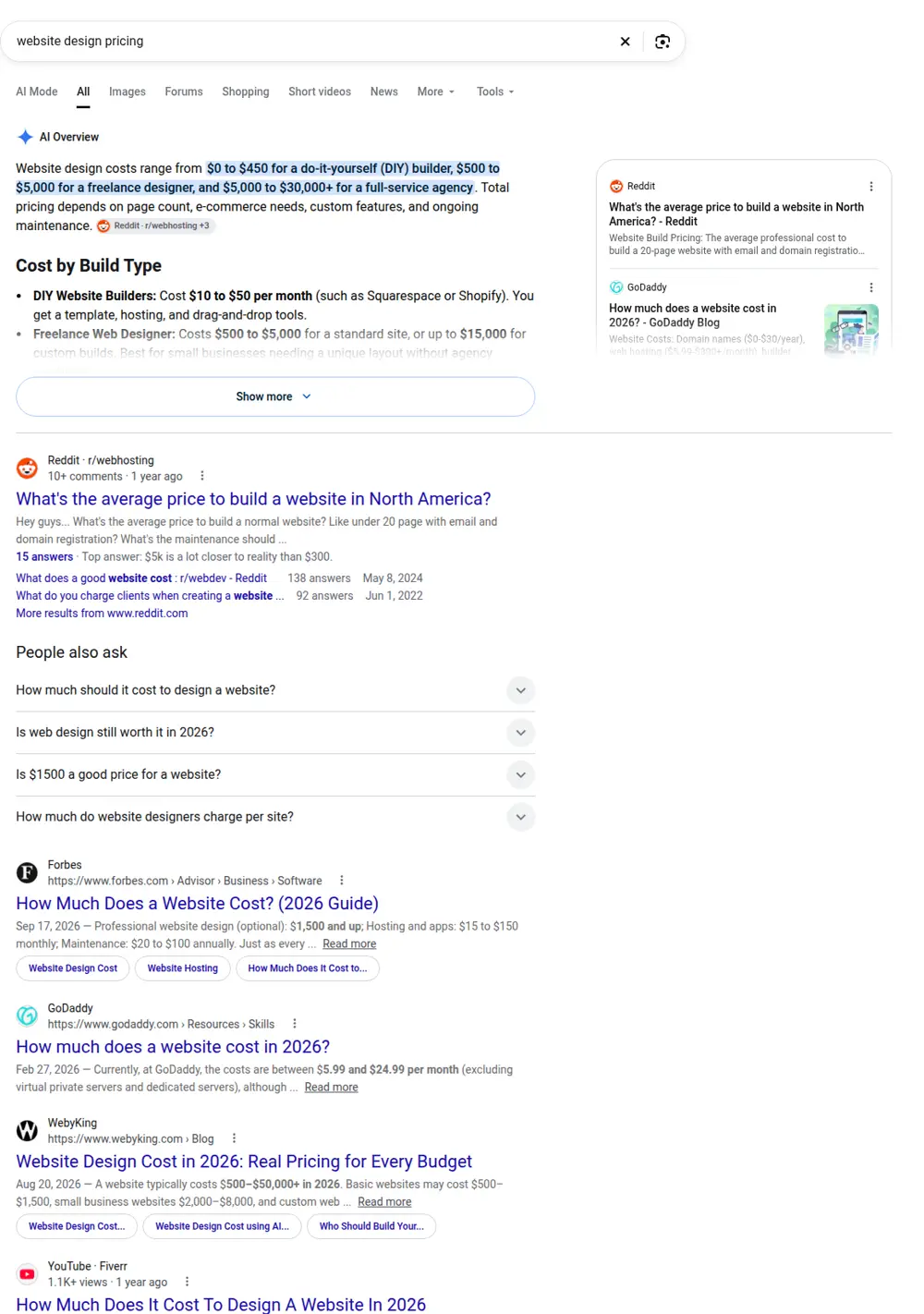
Here are the first organic results Google showed us for "website design pricing" (October 2026, via DataForSEO):
| # | Site | Page title | Type |
|---|---|---|---|
| 1 | reddit.com | What's the average price to build a website in North America? | Directory, forum or social |
| 2 | forbes.com | How Much Does a Website Cost? (2026 Guide) | Guide or article |
| 3 | webyking.com | Website Design Cost in 2026: Real Pricing for Every Budget | Guide or article |
| 4 | youtube.com | How Much Does It Cost To Design A Website In 2026 | Directory, forum or social |
| 5 | godaddy.com | How much does a website cost in 2026? | Guide or article |
| 6 | blog.atomicrevenue.com | Web Design Prices: The Complete Cost Breakdown of ... - Blog | Guide or article |
Web design pricing results start with a Reddit thread, then Forbes, GoDaddy and agency blogs, plus a YouTube video. Most give national averages. None can tell a local business what its own site should cost, which is the question the calculator answers.
How designers price their work
Fixed price
One price for a defined scope. Easy to budget. Make sure the scope lists every page.
Hourly
You pay for time. Fair for unclear projects, risky for budgets. Ask for an estimate in hours and a cap.
Monthly subscription
Little or nothing upfront, then a monthly fee that often includes hosting and edits. Check the total over three years and what happens if you leave.
Per page
Price grows with page count. Transparent, as long as each page has a reason to exist.
What moves the price up
- More pages. Each page needs layout, copy and images.
- Custom design instead of an adapted template.
- Copywriting and photos.
- Features: booking, payments, member areas, integrations.
- Online store with many products.
- Rounds of revisions and meetings.
- Agency overhead: project managers, strategists, account teams.
Running costs to add to any quote
| Item | Typical cost |
|---|---|
| Domain | $10 to $20 a year |
| Hosting | $36 to $500 a year |
| Business email | About $6 per user a month |
| Maintenance | $0 to $150 a month |
| Builder plan, if used | About $17 to $39 a month billed yearly |
More on upkeep in website maintenance cost.
Platform pricing in brief
| Platform | Plans billed yearly | Notes |
|---|---|---|
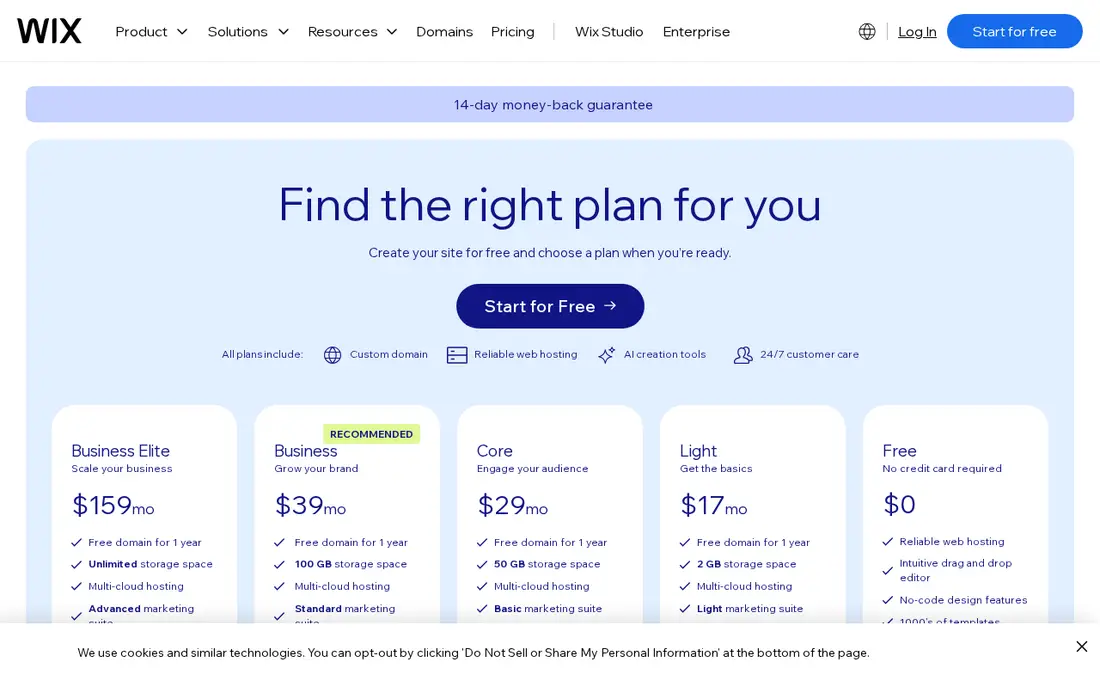
| Wix | Light $17, Core $29, Business $39, Business Elite $159 | Free plan with Wix branding |
| WordPress.com | Personal $4, Premium $8, Business $25, Commerce $45 | Self-hosted WordPress.org is free software |
Details: Wix website cost and WordPress website cost.
How to read a web design quote
- Every page listed by name
- Who writes content and supplies photos
- Number of revision rounds
- Hosting and domain: included, for how long, and the renewal price
- Ownership of domain, site and content
- Price for extra pages and later changes
- Timeline with dates
A quote without a page list is hard to compare. Two quotes at the same price can deliver very different sites.
Why cheap and expensive quotes differ so much
The gap between a few hundred and tens of thousands of dollars comes mostly from people and hours: meetings, strategy, custom design and content writing. Local service businesses rarely need most of that. They need fast pages that match what customers search, with a clear way to call.
That's real Search Console data from a client site, name hidden.
How our pricing works
We look up Google searches for your trade and city, recommend a page for each search group with real demand, and price by page:
| Item | Price |
|---|---|
| Home, about and contact | $299 |
| Each extra page backed by search data | $15 |
| Cap | $630 |
You see searches, pages and price in the website cost calculator before you pay. For package-style comparisons see website design packages. For small businesses, see small business website cost.
Pricing traps
- Comparing quotes by total only, without page lists.
- Low upfront, high monthly contracts that cost more over time.
- Paying hourly with no cap.
- Not owning your domain.
- Paying for features you won't use.
What people search about web design prices
Searches from DataForSEO:
| Search | Searches a month | What it shows |
|---|---|---|
| web design cost | 1,300 | General price research |
| cost of web page design | 1,300 | Price per page |
| how much does it cost to design a web page | 720 | Price per page |
| average web design cost | 320 | Wants a benchmark |
| web design cost calculator | 260 | Wants a quick estimate |
| how much should web design cost | 170 | Checking if a quote is fair |
| low cost web design | 140 | Price first |
| web design cost estimator | 140 | Quick estimate |
| web design cost for small business | 90 | Small business budget |
| wordpress web design cost | 90 | Platform-specific |
Two patterns stand out. Many people think in pages ("cost of web page design", "how much does it cost to design a web page"), and many want a calculator or estimator rather than a sales call. Both make sense: page count is the biggest driver of price, and a calculator gives a number without a meeting.
Price per page
Few designers publish a price per page, but most quotes come down to it. A quote of $3,000 for a 10-page site is roughly $300 a page. A quote of $15,000 for 20 pages is $750 a page. Dividing a quote by its page count is one of the fastest ways to compare offers, as long as both quotes include similar content help.
We price per page openly: $299 covers home, about and contact, and each extra page is $15, up to $630 total.
Total cost over three years
Upfront price is only part of it. Using our guide ranges:
| Route | Upfront | Yearly running costs | Three-year total |
|---|---|---|---|
| DIY on a builder | $0 | Builder plan ($17 to $39 a month billed yearly) plus domain after year one | About $612 to $1,404 in plan fees, plus domain and email |
| Freelancer, self-hosted | $1,000 to $5,000 | Hosting $36 to $500, domain $10 to $20, maintenance $0 to $1,800 | Upfront plus three years of running costs |
| Agency | $5,000 to $30,000 | Often a monthly retainer | Upfront plus retainer |
| SiteCostly | $299 to $630 | Domain and hosting | Upfront plus domain and hosting |
The builder figures are simply the plan price times 36 months. Email at about $6 per user a month adds about $216 per person over three years on any route.
What you get at each price level
| Price range | What's usually included | What's usually missing |
|---|---|---|
| Under $500 | A template, a few pages, basic setup | Content help, custom design, strategy |
| $500 to $1,000 | A template customized for your brand, several pages | Copywriting, ongoing support |
| $1,000 to $5,000 | Freelancer site with custom layout, more pages, some content help | Deep strategy, large content projects |
| $5,000 to $30,000 | Agency process: research, design, content, development, project management | Usually little, but you pay for process |
| Over $30,000 | Large sites, custom features, integrations, ongoing teams | Rarely needed by local service businesses |
Our site sits in the lowest range on price but includes the step most cheap sites skip: choosing pages from real search data for your trade and area.
Web design cost by business type
| Business | Typical number of pages | Why |
|---|---|---|
| Single-service trade in one town | 4 to 8 | Few services, one area |
| Multi-service trade across a metro | 10 to 25 | Each service and main suburb gets a page |
| Medical or dental practice | 8 to 20 | Each treatment, insurance, team |
| Law firm | 8 to 25 | Each practice area, attorneys, locations |
| Restaurant | 4 to 6 | Menu, hours, location, events |
| Ecommerce store | Dozens to thousands | Every product needs a page |
These are patterns, not rules. Your real page count depends on how many services and areas people actually search for. Examples by trade: web design for contractors, medical website design, web design for law firms.
How to use a web design cost estimator
A calculator is only as good as what it measures. Most calculators multiply features by a rate. Ours starts with demand: it looks up how many people search for your services in your area each month, groups those searches into pages, and prices by page. You see the searches, the pages and the price before paying. Try the website cost calculator.
Low cost web design without the usual trade-offs
Cheap sites usually cut corners in three places: speed, page planning and ownership. A low-cost site can still be fast if it's built lean. It can still have the right pages if they're chosen from search data. And you can still own your domain and content if that's in writing. Ask about all three before choosing on price.
Hourly rates
Some designers bill by the hour. Rates vary a lot by experience, location and specialty, so we don't quote a typical figure here. If you're billed hourly, ask for an estimate in hours for each part of the job, a cap, and weekly updates on hours used.
A quote comparison worksheet
| Quote A | Quote B | Quote C | |
|---|---|---|---|
| Upfront price | |||
| Number of pages | |||
| Price per page | |||
| Content included? | |||
| Revision rounds | |||
| Hosting cost per year after year one | |||
| Domain in your name? | |||
| Monthly fees | |||
| Three-year total | |||
| Timeline |
Filling this in for each quote makes the differences obvious, and often shows that the cheapest quote isn't the cheapest over three years, or that the most expensive one includes work you don't need.
Examples of our pricing
| Business | Pages beyond home, about and contact | Price |
|---|---|---|
| A business whose searches support 0 extra pages | 0 | $299 |
| A business with 5 extra pages backed by searches | 5 | $374 |
| A business with 12 extra pages | 12 | $479 |
| A business whose searches support many more pages | Capped | $630 maximum |
The real count for your business comes from the calculator.
Why web design prices vary so much
Two quotes for "a website" can differ by ten times or more, and both can be honest. The difference is in what's included and who does the work. A freelancer working alone from a template has low overhead. An agency with strategists, designers, writers, developers and project managers has high overhead and a longer process. A builder plan costs little in money and a lot in your time. None of these is wrong; they suit different businesses.
The most useful way to read any price is to ask what it buys. How many pages? Who writes them? How many rounds of changes? What happens after launch? Once those answers are on the table, prices usually start to make sense.
Freelancer pricing in detail
Freelancers typically charge $1,000 to $5,000 for a small business site. At the lower end, expect a template adapted to your brand, a handful of pages, and you supplying the text and photos. In the middle, expect more pages, some help with content, and a few rounds of changes. At the upper end, expect custom layouts, written content, basic SEO setup and a period of support.
Ask a freelancer about availability and backup. A solo freelancer who gets sick or busy can delay your project, and if they stop working, you need someone else who can maintain the site. Make sure you have logins for everything and that the site is built on a platform others can work on.
Agency pricing in detail
Agencies typically charge $5,000 to $30,000 for small and mid-sized business sites, and much more for large or complex ones. The price often covers discovery workshops, brand and messaging work, custom design, content writing, development, testing, project management and launch support. Many agencies also offer monthly retainers for ongoing changes and marketing.
For a business that needs that process, an agency can be worth it. For a local service business that needs a clear, fast site with a page for each service and area, much of the agency process adds cost without adding calls.
DIY pricing in detail
Building it yourself on a builder costs the plan fee, a domain after any free first year, and email if you want it. Wix plans run $17 to $39 a month billed yearly for most small business needs; WordPress.com ranges from $4 to $45 a month billed yearly. The real cost is time: learning the tool, writing each page, choosing photos and testing on phones. For owners who enjoy it and have the time, DIY is a fine choice. For those who don't, it often ends with a site that's never quite finished.
Paying upfront, in installments or monthly
Payment structure changes the risk on both sides. Many freelancers and agencies ask for a deposit, often a share of the total upfront, with the rest at milestones or launch. That's normal. Be wary of paying everything upfront to someone you haven't worked with. Monthly subscription models spread the cost, but over three years they can total more than a one-time build. Our approach is a single fixed price shown before you pay, based on the pages your searches support.
What isn't included in most quotes
Many quotes leave out costs you'll still pay. The domain and hosting are often billed separately. Email accounts on your domain are separate. Paid plugins, apps or premium themes may be extra. Stock photos or a photographer cost money. Copywriting may be excluded or limited. Ongoing changes after launch are usually billed separately. Ask about each one, and add them to the quote before comparing.
How page count drives price
Every page needs a layout, text, images and a title and description for Google. More pages mean more work. That's why page count is the best single predictor of price, and why it matters to get the page list right. Too few pages and you miss searches customers make. Too many and you pay for pages nobody visits.
The right number comes from your customers' searches. A plumber in a mid-size city might see real searches for drain cleaning, water heater repair, sewer line repair and emergency plumbing, plus several suburbs by name. That's a clear page list. A business with one service in one town needs far fewer.
Getting the most from your budget
- Decide the page list from real searches before asking for quotes
- Prepare your photos, service details and service areas in advance
- Ask for fixed prices with a written scope
- Compare quotes by price per page and three-year total
- Keep the domain in your own name
- Choose a platform someone other than the builder can maintain
- Spend on pages that bring calls before spending on design extras
What a good price looks like for a local service business
For a plumber, electrician, cleaner, salon, dentist or similar local business, a good price buys a fast site with a page for each main service and area, clear calls to action, real photos and correct business details, on a platform that's easy to keep running. That can cost a few hundred dollars or a few thousand, depending on who builds it. Beyond that, extra money mostly buys custom design, more process and more meetings. Those can be worth it for some businesses, but they don't by themselves bring more calls.
Red flags in web design pricing
- No written scope. If the page list isn't in writing, the price isn't either.
- Domain registered in the designer's name.
- Monthly fees with no end date and no clarity on who owns the site.
- "SEO included" with no explanation of what that means.
- Very low prices with long contracts.
- Pressure to decide today.
Web design pricing for different industries
Prices shift with the kind of business, mostly because of page count and features.
Home services like plumbers, electricians, HVAC, roofers and landscapers usually need a page for each main service and each main town. Features are simple: click-to-call, a quote form, reviews and a gallery. These sites can be built well at modest prices; the value is in the page plan. See web design for contractors and HVAC website design.
Medical and dental practices need treatment pages, insurance information, new patient forms or links, and often online booking. Privacy matters for forms. See websites for dentists.
Law firms need practice area pages, attorney bios and intake forms, and content that follows advertising rules. Content review takes time. See web design for law firms.
Restaurants need a menu that's easy to update, hours, location, and reservation or ordering links. Few pages, frequent updates. See websites for restaurants.
Therapists and counselors need specialty pages, fees and insurance details, and a calm, private contact process. See websites for therapists.
Design versus development versus content
Quotes often bundle three kinds of work. Design is how the site looks: layout, colors, typography, images. Development is building it so it works: the platform, pages, forms, speed and mobile behavior. Content is what it says: page text, headings, titles for Google and photos. Each can be done by different people at different prices. When quotes differ a lot, the gap is often in content: one quote includes writing every page, the other expects you to supply it.
Custom design versus templates
A custom design is created for your business from scratch. A template is a pre-made design adapted to your brand. Custom design costs more and takes longer. Templates are faster and cheaper, and good ones look professional. For most local service businesses, a well-chosen template or lean build with your real photos and clear pages performs as well as custom design. Custom design makes more sense when brand differentiation is central to how you win customers.
SEO in web design pricing
Many quotes mention SEO. At a minimum, a new site should have a sensible page structure, a unique title and description for each page, proper headings, fast loading, mobile-friendly design and a sitemap submitted to Google. Those belong in any decent build. Ongoing SEO, like creating new content, earning links and managing listings, is separate work, usually billed monthly. Ask any designer exactly which SEO tasks are included in the price and which aren't.
How we keep our price low
We build for local service businesses only, with a lean approach and a fixed process. Pages are chosen from real Google searches for your trade and area through DataForSEO, so we don't spend time guessing. We use the same proven structure for every service page, adapted to your trade and area, instead of designing each site from zero. And the same three people plan, write and build every site, without account managers or handoffs. That's how a site starts at $299, with $15 for each extra page the searches support, and never more than $630.
When our pricing isn't the right fit
We don't build online stores, member portals or complex custom applications. If you need those, a freelancer or agency that specializes in them is the better choice, and the higher price reflects real extra work. We're a fit when you're a local service business that needs customers to find you on Google and call.
Does location change web design prices?
Designers in large, expensive cities often charge more, mostly because of their own costs. The work itself isn't different. A plumber in Dallas and a plumber in a small town need the same kind of site: fast pages, a page for each service and area, and an easy way to call. Our price is the same everywhere because the work is the same: $299 base, $15 per extra page, $630 maximum. What changes by location is how many pages your local searches support.
How long web design takes at each price level
Lower-priced projects usually move faster because there's less process. A builder site can go up in days. A freelancer project usually takes a few weeks. An agency project often takes several weeks to a few months. The biggest delays at every level are content and approvals, not design or code. Having your photos, service details and service areas ready can cut weeks off any project.
Who owns the website you pay for
Ownership is part of the price. Make sure you own the domain, have admin access to the site and hosting, and own the text and photos created for you. Some monthly website services keep ownership of the design or content, so leaving means starting over. Ask before you sign.
Our price, step by step
- Pick your trade and city in the calculator.
- See the searches. It checks monthly Google searches for your services in your area through DataForSEO.
- See the page plan. Searches are grouped into pages, ranked by demand.
- See the price. $299 covers home, about and contact; each extra page is $15, with a $630 maximum.
- A person reviews it. One of us checks the plan before work starts.
You see all of this before paying anything.
Pricing for multi-location businesses
Businesses with several locations need a page for each one, with its own address, hours, phone, map, team and reviews. That adds pages and therefore cost, but each location page can rank for searches in its own area, so the extra pages usually pay for themselves. Make sure each location's details match its own Google Business Profile exactly.
What happens if you need more pages later
Businesses grow: new services, new areas, new locations. Ask any designer what it costs to add a page after launch, and whether you can add pages yourself. Some charge a flat fee per page, some bill hourly, some include a few pages a year in a maintenance plan. We add pages at the same $15 per page, chosen from search data like the originals.
Web design pricing questions to ask on the first call
When you talk to a designer, a few questions get you to a real price quickly. How many pages do you think my business needs, and why? Who writes the content? What platform will you use, and who maintains it? What does it cost per year after launch? Who owns the domain and the site? How long will it take? Can I see two or three sites you built for businesses like mine? A designer who answers these clearly and in writing is usually one you can work with.
Is cheap web design worth it?
Cheap can be good value or a false saving. A low price is good value when the site is fast, has the pages your customers search for, and you own it. It's a false saving when it's slow, has one generic services page, or locks you into a contract. Judge a cheap quote by the same checklist as an expensive one: pages, speed, ownership and running costs. If it passes, the low price is a bonus, not a warning sign.