What "cheap web design" means in 2026
Ask ten people what cheap web design costs and you'll hear ten numbers. For most small businesses, "cheap" means somewhere between free and about $1,000 for the build. Above that you're in normal freelancer territory, and agency quotes usually start in the thousands.
The price alone doesn't tell you much. A $500 site can bring in calls every week, and a $5,000 site can sit unseen on page four of Google. What matters is what the money buys: how many pages, who writes them, who owns the result and what you'll pay every month after launch.
People search for this in a lot of ways. "Cheap web design", "affordable web design", "inexpensive web design", "low cost web design" and "web design for cheap" all show up in Google's data, per DataForSEO. They mostly come from the same person: a business owner who needs a website, doesn't have a big budget and doesn't want to get burned.
| What people type into Google | US searches per month |
|---|---|
| cheap web design | 260 |
| affordable website design | 720 |
| affordable web design | 320 |
| low cost web design | 140 |
| budget web design | 40 |
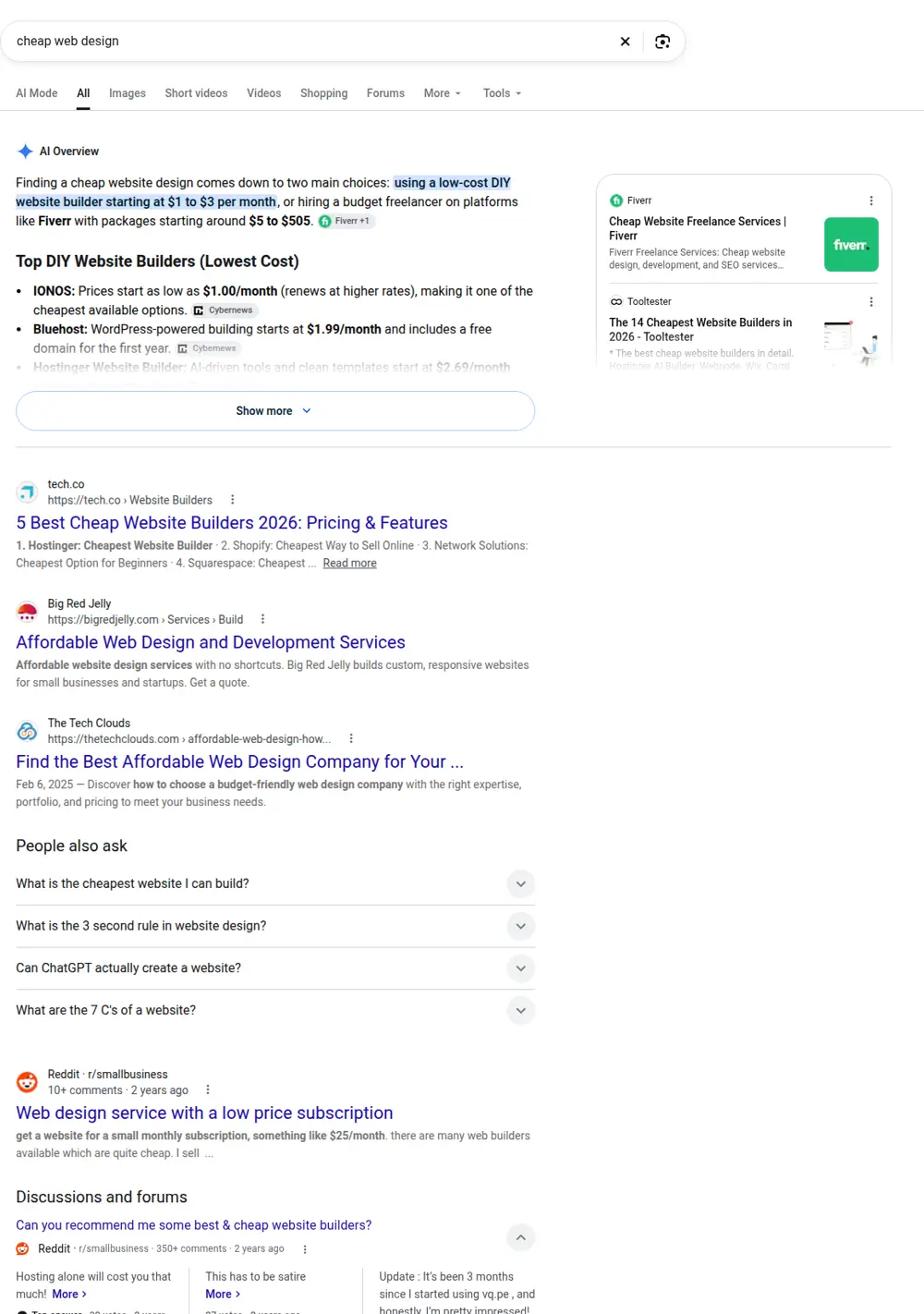
The top results are a mix of website builder roundups, agencies selling "affordable" packages and a few honest guides. Very few of them tell you where the cheap offers cut corners. That's what this page is for.
The four ways to get a cheap website
There are really only four routes to a low-cost site. Each one is cheap in a different way.
| Route | Typical upfront cost | Monthly cost | Who does the work |
|---|---|---|---|
| Free or low-cost website builder | $0 | About $10 to $40 | You |
| Template sold by a designer | $100 to $500 | Hosting, often $10 to $30 | Mostly you |
| Freelancer on a budget | $300 to $1,500 | Hosting, sometimes care fees | The freelancer |
| Fixed-price small team (like us) | $299 to $630 | Hosting, domain, email | The team |
Builders are cheap in cash and expensive in time. You pick a template, write your own text and set up everything yourself. Our guide to the cheap website builder options compares real plan prices.
Templates sold by designers look finished in the demo, but the demo is filled with sample text. Someone still has to write your services, your areas and your prices.
Budget freelancers can be great, and some of the best small business sites we've seen came from one person working alone. The risk is that quality and reliability vary a lot, and you often can't tell which kind you've hired until the site is late.
Small fixed-price teams sit in the middle. The price is set before work starts, the pages are planned for you, and the work doesn't depend on one person's schedule.
What a good cheap website must include
A low price is fine. A site missing the basics isn't, because a site nobody finds or trusts costs you more in lost jobs than it saved. Before you pay for any cheap web design service, make sure these are included:
- Your own domain, in your name. Not the designer's account, not a builder subdomain.
- A page for each main service. One "Services" page listing everything rarely shows up in search. A page for "drain cleaning" can.
- Pages for the areas you serve, where people search for them. Only build these where there's real demand and you actually work there.
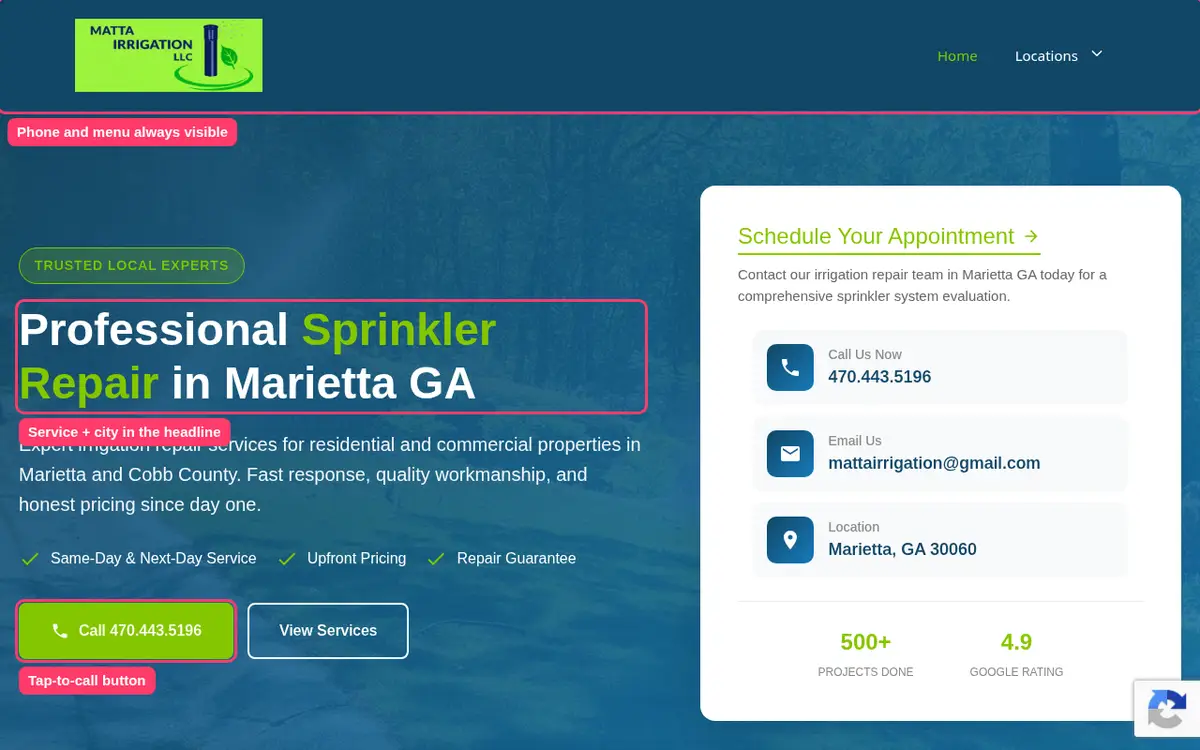
- A phone number you can tap on a phone. Most local customers find you on their phone, and many will call rather than fill in a form.
- Fast loading on mobile. Heavy sliders and auto-play videos are common on cheap templates and slow everything down.
- Basic SEO setup. Page titles, descriptions, headings that match what people search, a sitemap and a connected Google Business Profile.
- Real photos where you have them. Stock photos of smiling people in hard hats don't convince anyone.
- A way to change small things later. Hours, prices and phone numbers change, and you shouldn't need to pay a developer every time.
If a cheap offer covers all eight, it's a good deal. If it skips the first three, it isn't cheap. You'll pay for it later, either to fix it or in work that went to a competitor.
Where cheap web design usually cuts corners
Low-cost designers have to save time somewhere. Some shortcuts don't matter. Others cost you customers. Here's where we see corners cut most often.
The text is generic or missing
Writing is the slowest part of building a small business site. So cheap offers often skip it. You get a template with "Lorem ipsum" or vague lines like "We provide quality service at competitive prices". Google can't tell what you do or where, and neither can customers.
Ask who writes the text. If the answer is "you", budget the time. A ten-page site needs a few thousand words, and writing them well takes most people a couple of weekends.
Only three to five pages
A home page, an about page, a services page and a contact page is the classic cheap package. It looks complete. But each page can only rank for a handful of searches, so a four-page site has very few ways to be found.
Compare that with how people actually search: "emergency plumber [your city]", "water heater installation [your city]", "drain cleaning near me". Each of those needs its own page to have a real chance.
The site isn't really yours
Some low-cost web design companies keep the domain in their own account, or build the site on a system only they can access. As long as you pay the monthly fee, it works. When you stop, the site goes away, and sometimes the domain does too.
This is the most expensive trap in cheap web design, because you lose everything you paid for and have to start over. Always get the domain registered in your name, and ask what happens to the site if you cancel.
The real price is monthly
"Website for $0 down" usually means a contract at $50 to $300 a month, often for 12 to 24 months. Over two years that can add up to several thousand dollars, which is more than many custom sites cost upfront. Monthly plans aren't always bad, but compare the total over two years, not the first payment.
No SEO at all
Many cheap sites are never set up for search. No page titles, no descriptions, images without names, no sitemap and no Google Business Profile connection. The site exists, but almost nobody finds it.
Slow, heavy templates
Cheap themes often come loaded with sliders, animations and plugins to look impressive in the demo. On a phone with a weak signal, the page can take several seconds to load, and visitors leave.
Red flags in cheap web design offers
Some warning signs come up again and again. If you see two or more of these, walk away:
- "Unlimited pages" for a tiny price. Nobody writes unlimited pages for $200. Usually you get unlimited empty pages to fill yourself.
- "Guaranteed first page on Google." Nobody controls Google's results. Anyone who guarantees rankings is guessing or lying.
- No examples you can visit. Screenshots are easy to fake. Ask for links to live sites and check them on your phone.
- No written scope. If the quote doesn't say how many pages, who writes them and what's included, the price will grow.
- The domain stays with them. Covered above. It should always be yours.
- Pressure to sign today. A discount that "ends tonight" is a sales tactic, not a reason to buy.
- Long contracts with cancellation fees. Check how long you're locked in and what leaving costs.
Cheap web design vs a free website builder
If price is the only thing that matters, a free builder wins. You can publish a basic site for $0. But a free site comes with the builder's ads, a builder address like yourname.builder.com and limits that push you toward a paid plan.
Most business owners end up on a paid builder plan within a few months. At $15 to $40 a month, that's $180 to $480 a year before email, apps and your own time. For a site you'll keep for three years, that's $540 to $1,440 in plan fees, and you still did all the work.
Cheap web design, done by someone else, flips that around. You pay once for the build, then only for hosting, the domain and email. Whether that's better depends on your time. If you enjoy building and writing, a builder can work well. If you'd rather spend your weekends on paying jobs, paying for the build usually costs less in the end.
How much should cheap web design cost?
There's no official price list, but these ranges match what we see quoted to small businesses in the US:
| Price | What you usually get |
|---|---|
| Under $300 | A template set up with your logo and contact details. Little or no writing, few pages, often no SEO. |
| $300 to $700 | A small site with real pages for your main services, basic SEO and mobile-ready design. Quality varies a lot. |
| $700 to $1,500 | More pages, better writing and some local SEO. Often a freelancer or a small studio. |
| $1,500 and up | Standard freelancer and agency pricing. Custom design, more pages and more meetings. |
Our own price sits in the second band. The calculator plans your pages from real Google searches in your area, then prices them: $299 for the home, about and contact pages, plus $15 for each extra service or city page, never more than $630. You see the page plan and the price before we ask for an email.
For a wider view of what websites cost at every level, see our guide on how much a website costs. If you're comparing quotes line by line, our website design pricing page explains how designers price their work.
Cheap web design and hosting
Many cheap web design offers bundle hosting. That's convenient, but check three things:
- What hosting costs after the first year. Intro prices often jump at renewal.
- Whether you can move the site. If the site only runs on their system, you're locked in.
- What's included. SSL, backups and email are sometimes extra.
For a small site, hosting usually costs a few dollars to about $30 a month. A domain costs about $10 to $20 a year. Email on your domain is about $6 per person per month with Google Workspace or Microsoft 365. Those are the running costs you'll pay no matter who builds the site.
Cheap custom web design: is it possible?
Fully custom design, where every layout is drawn from scratch, takes time, and time costs money. You won't get that for a few hundred dollars from anyone who plans to stay in business.
What you can get cheaply is a site built on a well-made, fast template, filled with content written for your business and your area. For a local service business, that's what moves the needle. Customers care that they can see what you do, where you work, what it costs and how to call you. They don't care whether the layout was drawn from scratch.
How to keep your website cheap without hurting it
You can lower the cost of any web design project with a few choices:
- Start with the pages that bring work. Your main services and main areas first. A blog and a gallery can come later.
- Gather your material before you start. Logo, photos, services, areas, prices, licenses and a few reviews. Designers charge for waiting and chasing.
- Take your own photos. A phone photo of your real team or a finished job beats stock photos.
- Write down what makes you different. Even a few bullet points save the writer time and make the text more accurate.
- Skip features you won't use. Online booking, chat widgets and animations add cost. Add them when you actually need them.
- Avoid long contracts. Pay for the build, then keep hosting and maintenance flexible.
- Keep the domain in your name. It costs nothing extra and protects everything else you paid for.
Cheap WordPress web design
A lot of low-cost designers build on WordPress, because the software is free and there are thousands of themes. That can work well. WordPress is flexible, you own your content, and almost any developer can work on it later.
The catch is upkeep. A self-hosted WordPress site needs updates to WordPress itself, the theme and every plugin. Skip them for a year and you can end up with a slow or hacked site. Before you buy cheap WordPress web design, ask:
- Who installs updates after launch, and what does it cost?
- How many plugins does the site use? Fewer is better.
- Is there an automatic backup, and where is it stored?
- Which hosting will it run on, and what does that cost after the first year?
If nobody will look after it, a hosted platform can be safer for a small business. Our WordPress website cost page explains the running costs in detail.
When cheap web design is the wrong choice
A low-cost site isn't right for every business. Spend more if:
- You sell hundreds of products online. Stores need inventory, shipping, tax and payment setup, and that takes more time than a service site.
- You need custom tools. Quote calculators, client portals, booking systems tied to your software or member areas all add development work.
- You're in a regulated field with complex rules. Some medical, legal and financial businesses need extra review of every page.
- Your brand is the product. If you sell design, fashion or luxury services, the look of the site matters more than usual.
For most local service businesses, none of these apply. A clear, fast site with the right pages is what brings the calls.
What to send your designer to keep the price down
The more you prepare, the less time a designer spends chasing details, and the cheaper and better the site will be. Send these in one email:
- Your business name, phone, email and address (or service area if you don't have a public address).
- A list of every service you want customers to find, with one or two lines on each.
- The towns or neighborhoods you work in, starting with the most important.
- Prices or price ranges, if you're comfortable sharing them.
- Licenses, insurance and certifications.
- Ten to twenty photos of real work, your team and your vehicles or premises.
- Three to five reviews you're proud of, with the customer's first name.
- Your logo, in the best quality you have.
Is cheap web design worth it?
For most local businesses, yes, if the low price comes from efficiency and not from skipping the work. A plumber, cleaner or salon doesn't need a $10,000 site. They need a fast site with the right pages, written for the way people in their area search.
Cheap web design isn't worth it when the site is rented, the text is generic or nobody sets it up for search. In those cases you pay twice: once for the cheap site and again when you replace it.
What we do to keep our price low
We're a team of three: Julián Durango, Luisa Salazar and Efraín Zea. Our price is low for a few concrete reasons:
- No sales meetings. The calculator does the quoting, so we don't spend hours on calls before you buy.
- Page plans come from data. We check real Google searches for your trade in your area instead of guessing which pages to build.
- Software handles the repetitive parts. Setting up hosting, sitemaps and page structures is automated, so our time goes into writing and checking your pages.
- A fixed scope. You see exactly which pages you get. No surprises, no hourly billing.
We still review every plan by hand before work starts, and you review a draft before anything goes live. You can also book a free 30-minute call if you'd rather talk first.
Cheap web design for different kinds of businesses
What a low-cost site needs depends on how your customers find you.
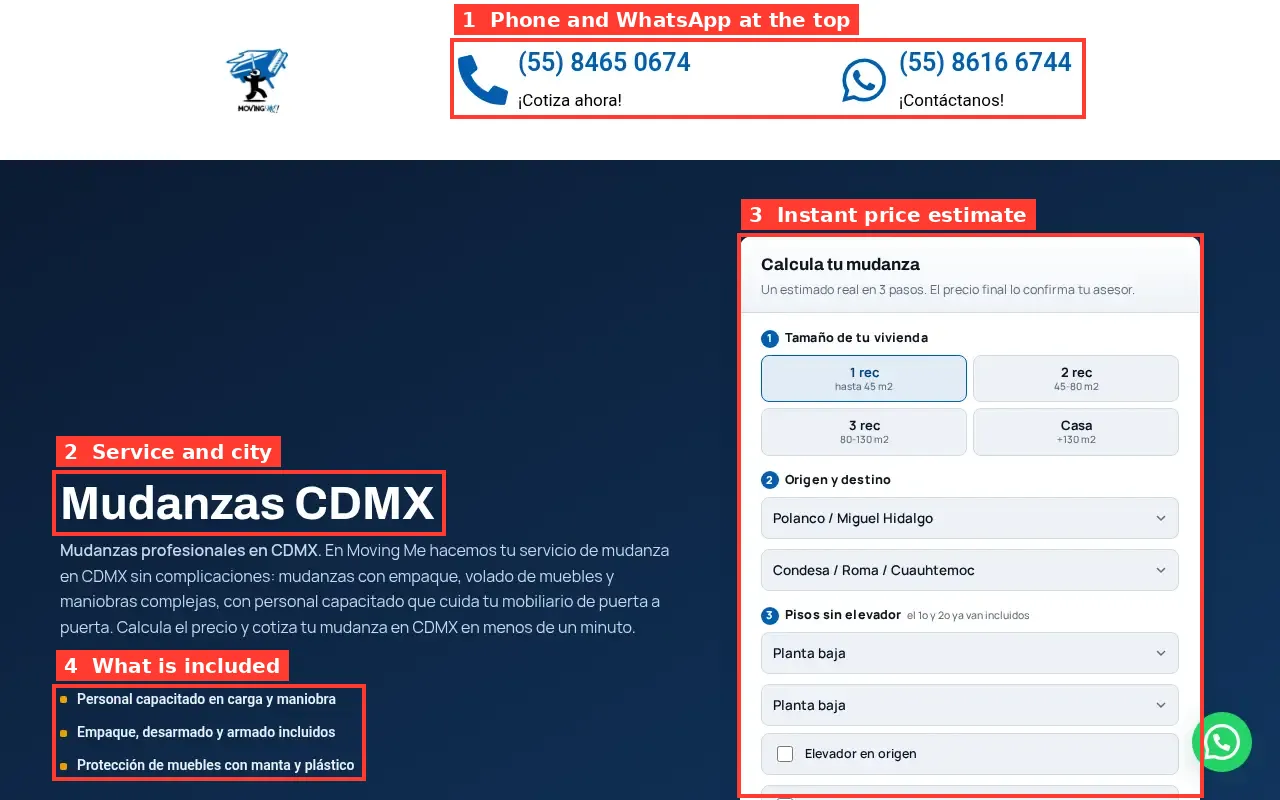
Trades and home services. Plumbers, electricians, roofers and cleaners need one page per service and per area they work in, plus a big call button. See our websites for plumbers page for an example of how we plan these.
Clinics and health practices. Patients look for a specific treatment, insurance details and a booking button. Privacy matters too.
Restaurants and salons. Menus, hours, booking and photos come first. A menu in text form, not a PDF, helps both customers and Google.
Professional services. Accountants, lawyers and consultants need clear service pages and trust signals: credentials, reviews and a real photo of who customers will deal with.
Questions to ask before you hire a cheap web designer
Use this list on every quote, whatever the price:
- How many pages do I get, and how did you decide that number?
- Who writes the text, and can I see a sample?
- Will the domain and site be in my name?
- What do I pay every month after launch, and for how long?
- What happens to my site if I stop paying you?
- Can I edit hours, prices and phone numbers myself?
- How do you set up SEO and Google Business Profile?
- Can I see three live sites you built?
- How long until launch?
A good designer at any price will answer these happily. A bad one gets vague.