How people hire a moving company
Moving is stressful and usually comes with a deadline. Someone has a lease ending, a closing date or a new job starting. They search on their phone, open three or four movers, and contact whoever answers the big questions fastest: Do you serve my area? Roughly how much will it cost? Can you do my date? Are you legit?
A moving company website has to answer all four on the first screen. Everything else on the site supports those answers.
Searches for "movers" plus a city name are large in every big metro. Austin leads this list with about 22,200 a month, followed by New York at 18,100 and Dallas and Chicago at 14,800 each, per DataForSEO. Even a share of that demand in one city can keep several crews busy.
| What people type into Google | US searches per month |
|---|---|
| moving company website design | 140 |
| moving company website | 170 |
| moving company website template | 40 |
On the business side, "moving company website" gets about 170 searches a month and "moving company website design" about 140. Around 40 people a month search for a "moving company website template", per DataForSEO.
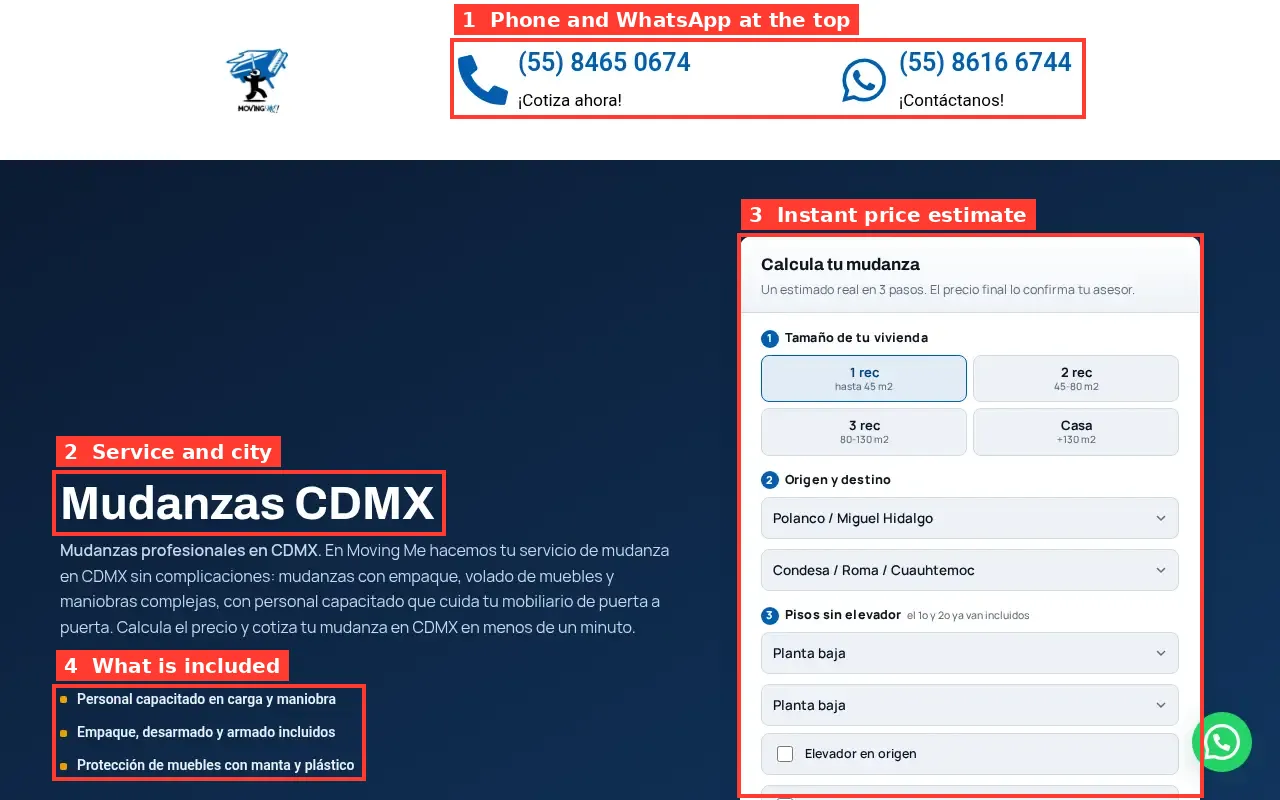
A real example: Moving Me in Mexico City
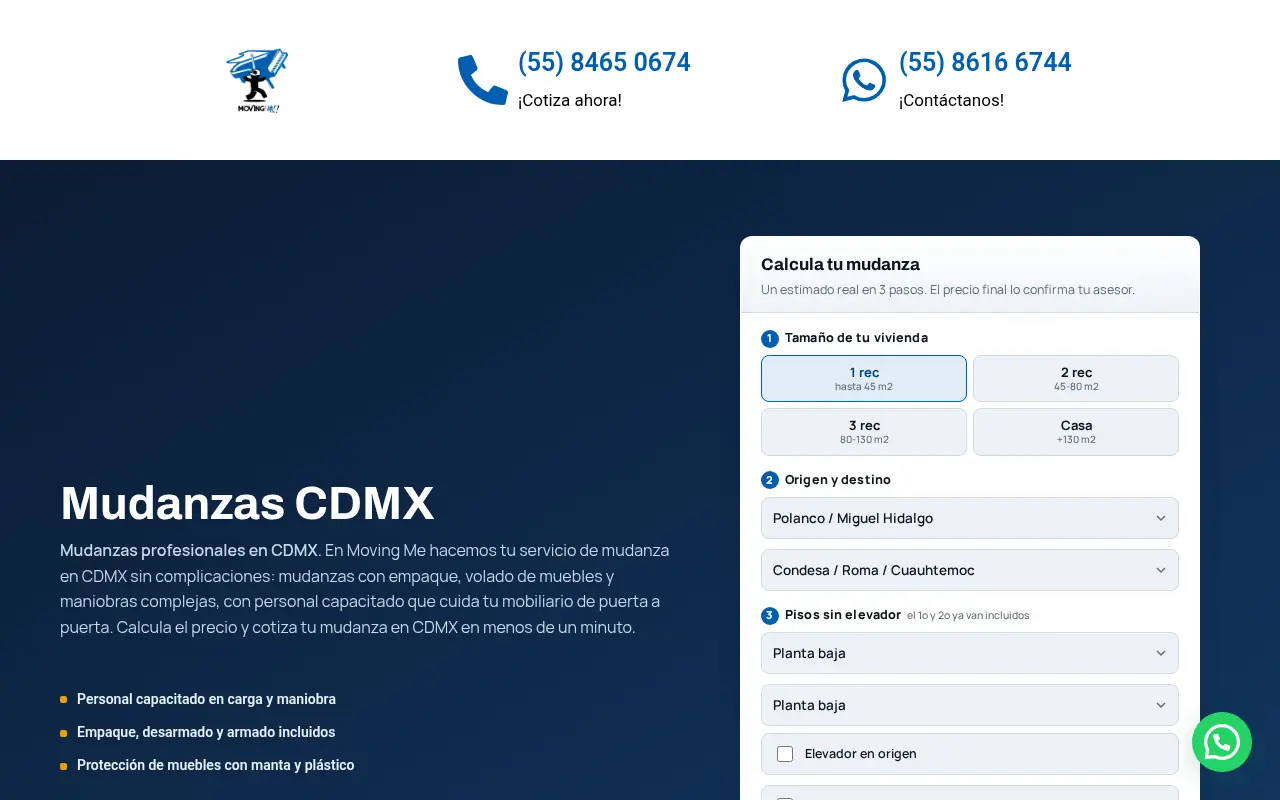
We built the site for Moving Me (movingmemx.com), a moving company in Mexico City. The site is in Spanish and was designed around how people in the city actually hire movers.
WhatsApp first. In Mexico, most people prefer to message rather than call. The WhatsApp button sits in the header and follows the visitor down the page, so starting a conversation takes one tap.
An instant price calculator. The hero promises a quote "en menos de un minuto" (in less than a minute). Visitors choose the size of the move and the route and get an estimate right away. People who see a number are far more willing to message.
A page for every borough. Mexico City has 16 alcaldías, and the site has a page for each one. People search for movers in their own borough, and those pages give Google a precise match.
Separate service pages. Local and residential moves, office moves, national moves, storage rental, and small moves and fletes (van hire) each have their own page. Someone looking for a small van for a few boxes doesn't want to read about full office relocations.
What the traffic looks like
This chart shows monthly clicks from Google over the last 12 months. Clicks peaked at 713 in May 2026, and impressions peaked at about 55,054 in March 2026. Since June, clicks have dropped, to 279 in September.
We're showing the decline on purpose. Moving searches are seasonal, competition in big cities is intense and Google's results change often. A good website gives a moving company a strong base, but it isn't a one-time fix. Keeping city pages fresh, adding reviews and photos and watching Search Console every month matters as much as the launch. If someone promises you traffic that only goes up, be careful.
Pages a moving company website needs
Home page
The first screen should show what you do and where, a phone number, a messaging button if your customers use one, and a way to start a quote. Below that: your main services, the areas you cover, a few reviews, and proof that you're licensed and insured.
Quote page or estimator
The quote form is the most important part of the site. Keep it short:
- Moving from (zip code or neighborhood)
- Moving to
- Size of the move (studio, 1 bedroom, 2 bedrooms, house, office)
- Preferred date
- Phone or email
You can ask about stairs, elevators, special items and packing later, on the phone. Every extra field loses people.
If you can give a range instantly, do it. An estimator with a few choices and a clear note that the final price depends on the inventory works well. If you can't, promise a reply time and keep it.
Service pages
Give each service its own page:
- Local moves
- Long-distance or interstate moves
- Office and commercial moves
- Packing and unpacking
- Storage
- Small moves and junk removal, if you offer them
- Specialty items like pianos, safes or art
Each page should explain what's included, how pricing works for that service, what the customer needs to do and how far ahead to book.
City and neighborhood pages
Most searches for movers include a place name. A page for each main city or neighborhood you serve, with details that are actually local (building types, parking rules, common routes, how far you travel), gives you a chance to appear for those searches. Avoid copying the same text with the city name swapped. Google and customers both notice.
Reviews and trust
Moving scams are common enough that people check carefully. Show:
- Your license numbers, such as USDOT and MC numbers for interstate moves in the US
- Insurance and valuation options, explained in plain words
- Real reviews with names and dates, ideally linked to your Google Business Profile
- Photos of your real trucks and crews, not stock images
About page
Who owns the company, how long you've been moving people, where your trucks are based. Family-owned movers should say so. It's a real advantage.
How to show prices without a price list
Moving prices depend on distance, volume, stairs, packing and the date, so most movers avoid prices online. But people want an idea before they call. Options that work:
- Hourly rates for local moves. "Two movers and a truck from $X per hour" is clear and honest.
- Typical ranges. "Most one-bedroom local moves cost between X and Y."
- An instant estimator. Like the Moving Me example, a few choices that return a range.
- Explained extras. Stairs, long carries, packing materials, weekend dates.
Clear pricing pages also reduce bad-fit calls, so your team spends less time on quotes that go nowhere.
Speed and mobile
Most people searching for movers are on their phones, often in the middle of other moving tasks. Pages need to load fast on mobile data. We compress every photo, avoid heavy sliders and keep the phone and quote buttons within reach of the thumb. We check every site with Lighthouse on mobile before launch.
Moving company website templates
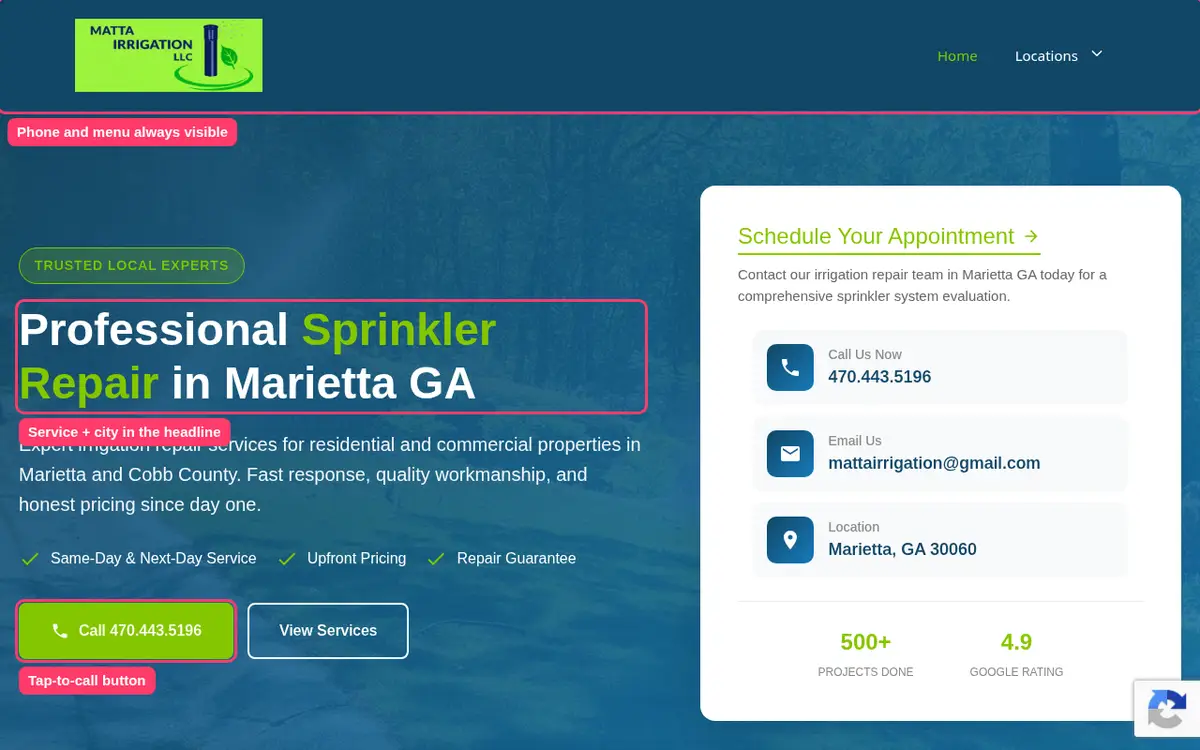
A moving company website template can get you a clean layout quickly, and for a brand-new company it's a reasonable start. The problems show up later: templates rarely include a real estimator, city pages take a lot of manual work, and many load slowly because of features you don't use. If you start with a template, focus your effort on the quote form, the service pages and real photos.
Common mistakes on moving company websites
- The phone number is hidden in the footer.
- The quote form asks for a full inventory before giving any answer.
- One page tries to cover every city.
- Stock photos of smiling people holding boxes instead of your own crew.
- No license or insurance information.
- Reviews copied as text with no names or links.
- Seasonal promotions still showing months later.
Building trust when scams are common
Moving has a reputation problem. Many people have heard stories of movers who quote low, load the truck and then demand more money before unloading. Your website is where you prove you're different. Some things that help:
- Explain how your estimates work. Say whether you give binding, non-binding or not-to-exceed estimates, and what each one means in practice.
- Show your physical address. A real office or warehouse address, with a photo, is reassuring. A company with only a phone number looks risky.
- Explain deposits. If you take a deposit, say how much and when. Reputable movers rarely ask for large deposits up front.
- Link to official records. For interstate moves in the US, link your USDOT number to the public FMCSA lookup so people can check you.
- Name the team. A short "meet the crew" section with first names and photos makes people more comfortable letting strangers handle their belongings.
Packing, storage and extra services
Many moving companies earn a lot of their margin from services beyond the move itself. Each deserves a clear explanation:
Packing. Full packing, partial packing (kitchen only, for example) and fragile-only packing. Explain what materials are included and how the price is calculated.
Storage. Short-term storage between homes, long-term storage, climate control, access hours and how items are protected. Moving Me offers storage rental as a separate service page, and it brings in searches that a general moving page would miss.
Small moves. Single items, a few boxes, a student room. Many big movers ignore these, which makes them an opportunity. A separate page for small moves catches people searching for "small movers" or van hire.
Junk removal and donations. If you haul away what people don't want to move, say so. It's a real time saver for customers.
What to put in a moving company FAQ
A good FAQ answers what your office hears on the phone every day:
- How far in advance should I book?
- What do I need to do before the movers arrive?
- What items won't you move?
- How do you protect floors and furniture?
- What happens if something gets damaged?
- Do you move on weekends and holidays?
- How do you charge for travel time?
Answering these on the site saves your team time and helps people decide faster.
Office and commercial moves
Businesses hire movers differently from families. An office manager usually needs a formal quote, a certificate of insurance for the building, a plan for moving IT equipment and a move that happens over a weekend or at night so work isn't interrupted. A commercial moving page should say you handle all of that, show a few companies you've moved (with permission) and offer a site visit instead of a quick online estimate.
Moving checklists
A printable moving checklist, with tasks for eight weeks, four weeks and one week before the move, is useful and gets shared. Ending it with a quote button turns readers into leads.
Seasonality and how to plan for it
Moving demand peaks in late spring and summer in the US, and around month-end everywhere. Your website can help smooth this out:
- Publish an "off-season" page or note encouraging people to book in slower months.
- Add a "book early" message for summer dates.
- Update your FAQ with the questions you hear most in each season.
The Moving Me chart above shows how much traffic can move from month to month, which is one reason to plan content ahead of the busy season.
Real Search Console data from another service site
This chart comes from a different service business site we built. It shows the more typical pattern after launch: steady growth as each service and area page starts to rank.
Building your moving company website
Plan. Use the calculator to price your site and see how many people search for movers in your cities. We confirm the service list and the areas that deserve their own page.
Content. You send photos of your trucks and crew, your license details and a short note on how you price. We write every page.
Build. We design the site, set up the quote form or estimator and make sure every page loads fast on a phone.
Review and launch. You review a draft, ask for changes and approve. We connect Google Search Console and your Google Business Profile and check that the quote form reaches you.
Price
The base is $299. Each extra page adds $15, and the price never goes above $630. A mover with five services and eight city pages pays $299 plus 13 × $15, or $494. If you serve every borough of a large city, like Moving Me's 16 alcaldías, the cap keeps the cost predictable.
Use the calculator to get your exact price.